Fonterra FY26 Results: $9.69 Milk Price, $3.4bn Profit
Fonterra has unveiled its annual results for the 2026 financial year, posting $27 billion in revenue and close to $20 billion returned to New Zealand farmer owners and unit holders.
 increase font size
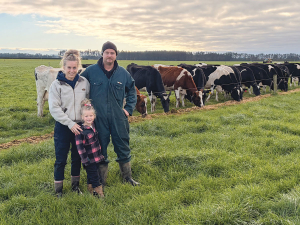
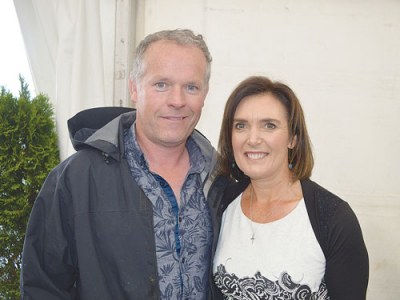 She’s back – re-elected Fonterra director Leonie Guiney with husband Kieran at the co-op’s annual meeting earlier this month.
Fonterra's inconclusive director election is raising questions among shareholders.
As predicted in the last Rural News, the revised director voting threw a hung result: only two candidates passed the 50% ‘yes’ vote threshold, leaving one director vacancy unfilled.
Federated Farmers Waikato president Andrew McGiven believes the election process needs better transparency.
Expressing surprise that the co-op only elected two directors to fill three board vacancies, McGiven says shareholders are demanding clarification.
“There is still a lot of conjecture around this, hence the dissatisfaction among shareholders who nominated the two outside candidates,” he says.
“I think the farmer message to the board is that they are accountable to us as shareholders. I don’t know why the other two board nominees were not elected, but I think there is a clear message to the board -- and to a certain extent senior management -- that they aren’t greater than Fonterra itself, and in the end are accountable to us as shareholders and suppliers.”
Five candidates contested the board elections; the board backed three candidates through the independent nomination process: sitting director Ashley Waugh and new candidates Peter McBride and Jamie Tuuta.
Two candidates -- Leonie Guiney and John Nicholls -- were nominated by farmers. Only McBride and Guiney were successful.
Guiney, who served a three-year term on the board, thanks shareholders for trusting her.
“I take that responsibility very seriously; it’s a very strong mandate, a mandate to protect the coop’s assets for the long term, but also to reallocate our resources to where we are most competitive,” she told Rural News.
“For me this was the test of whether farmers were engaged enough to create constructive change. They are: 68% came out and voted.
“When co-op members care enough to vote the co-op has a future, and when the board members have a strong mandate from their members the board can get on with their job while retaining one of the greatest advantages a co-op has -- loyal supply.”
Guiney had a testy relationship with the previous chairman John Wilson; a court case between Guiney and the board over alleged leaking of confidential information was settled out-of-court after Wilson stepped down as chairman in July.
McBride, the outgoing chairman of Zespri, was overwhelmed with the response in the election.
“I want farmers to know I will do my very best and I will work hard for them,” he told Rural News. “It was a good result. I was quite surprised at the outcome with only two people making it through but I guess that is the system.”
He says going into the election he was concerned the farmers may “just see me as a kiwifruit guy”.
“But I think when they got to meet me in person and heard what I had to say then they understood I had something to offer.”
Waugh, a sitting director, refused to comment on his ousting from the board.
Biggest losers
So, who are the biggest losers from the flawed Fonterra director election process?
The two board-backed candidates Ashley Waugh and Jamie Tuuta- who exposed themselves to the rigorous process and were hung out to dry.
The shareholder Council, which ran the process. The system is flawed and the council got the mood of the farmers completely wrong.
The independent assessment panel who vetted possible candidates and recommended three candidates to the board. Only one candidate was successful. Why would these top business minds offer themselves to sit on a committee, whose recommendation is ignored by farmers?
Fonterra has unveiled its annual results for the 2026 financial year, posting $27 billion in revenue and close to $20 billion returned to New Zealand farmer owners and unit holders.
Fonterra Co-operative Group has confirmed the independently assessed candidates standing for election to its board in 2026.
Fonterra has revised its Farmgate Milk Price forecast for the 2026/27 season, lifting the midpoint and narrowing the range on the back of improving global dairy commodity prices.
Outgoing Fonterra Co-operative Council chair John Stevenson says that it has been a privilege to represent the co-op's farmer shareholders.
OPINION: It seems Canterbury processor Synlait is still in the doldrums.


Federated Farmers says it welcomes Labour's commitment to reviewing the Sharemilking Agreements Act, calling on other major parties to do the same.
For Canterbury dairy farmers Sian Meijer and Rick Wobben, wearable technology has become one of their most valuable on-farm tools - helping manage 1850 cows across an expansive, high-performing dairy operation while improving efficiency, mating outcomes and day-to-day decision making.
Fonterra has unveiled its annual results for the 2026 financial year, posting $27 billion in revenue and close to $20 billion returned to New Zealand farmer owners and unit holders.
The first major update to the Dairy Cattle Code of Welfare in more than a decade has been released, marking what DairyNZ describes as an important step in ensuring animal welfare standards continue to evolve alongside scientific evidence and on-farm realities.
Ravensdown shareholders have elected Jane Montgomery and Kate Acland to the Ravensdown Board for three-year terms, following a closely contested director election.
Federated Farmers says new legislation replacing the Resource Management Act will cut red tape, unlock investment and help grow New Zealand's export-led economy, after the Planning Bill and Natural Environment Bill passed their third reading in Parliament yesterday.




