What Would Synlait Be Worth to Fonterra or a2 Milk?
Speculation of a possible joint move by Fonterra and a2 Milk to buy Synlait raises a much bigger strategic question, says agribusiness expert Dr Nic Lees.
 increase font size
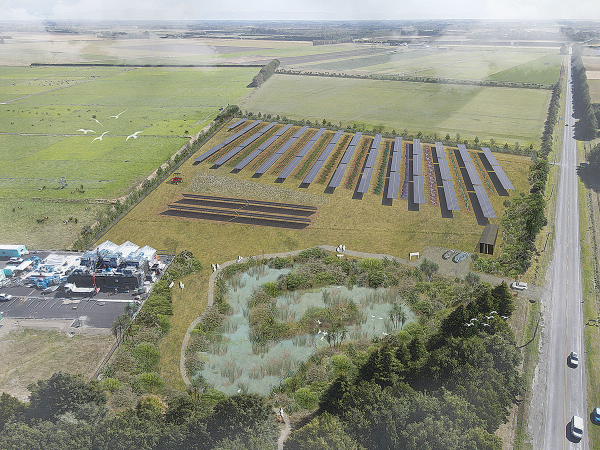 A visualisation of the Lincoln University Energy Farm.
Plans are afoot for an energy farm, which will demonstrate how productive land can be optimised to grow high-value horticulture crops while generating commercial-scale solar energy.
The Lincoln University Energy Farm, which is currently under review for resource consent, will be constructed on a 4ha parcel of university-owned land adjacent to the campus.
The university says that a distinctive feature of the Energy Farm will be its ability to host a comprehensive range of experiments and crop trials to help develop “leading-edge practices that can be replicated and rolled out across New Zealand and the world”. The increase in biodiversity will also be a subject of research, with extensive native planting around and within the site for crop wind protection, onsite water management and improved aesthetics.
The 1.5 MWp solar installation will comprise around 2,800 photovoltaic (PV) panels, generating ~2.3 GWh of renewable energy per year. The rows of bifacial PV panels will be mounted on a state-ofthe- art east-west tracking system, with two different height configurations, allowing for commercial crop production alongside and underneath the panel structures.
The specific high-value crops to be co-located with the solar array are yet to be determined but are likely to be blueberries, ranui berries or snowberries.
Next to the main array, a second smaller array will be dedicated to multi-use research as its main function, with complete manual control, different height and panel configurations, and different panel technologies.
The new Energy Farm will be the first demonstration of high-value agrivoltaics in New Zealand. While livestock grazing is commonly practised within solar installations locally and internationally, this approach is primarily for the purpose of managing grass growth and is relatively low value.
Lincoln says it was also the first New Zealand university to generate solar energy on a commercial scale, with several campus buildings supporting large roof-and-wall-mounted solar arrays.
Scheduled for completion mid-2025, the energy farm is expected to increase the university’s total generating capacity to approximately ~3.56 GWh, covering 18% of the campus’s annual electricity requirements after the heating system upgrade to 100% electric power.
Most of the energy generated by the new array will be used by the Lincoln campus, though the university will be looking to donate excess energy to the nearby community during low-demand periods like the end-of-year break and summer weekends.
Lincoln University’s chief operating officer, Susie Roulston, said the proposed energy farm is key to the university’s goal to become carbon neutral by 2030 and carbon zero by 2050.
“Our multi-disciplinary approach has enabled decarbonisation and a novel agrivoltaic system.”
Speculation of a possible joint move by Fonterra and a2 Milk to buy Synlait raises a much bigger strategic question, says agribusiness expert Dr Nic Lees.

Lynnette Hudson's 30-year obsession with Pinot Noir was sparked working vintage in Burgundy, seeing how subtle changes in terroir were expressed in the glass. It was, she says, "an elightening moment in every way".
A four year trial has reaffirmed that mixing plantain into dairy pastures can help reduce nitrogen losses to freshwater while maintaining milk production and profitability, say researchers.
Twenty five secondary school students from around New Zealand recently completed a three day residential programme designed to explore career opportunities across the food and fibre production supply chain.
A Lincoln University student is set to become the first person to contest both the Young Viticulturist and the Young Winemaker national titles in one year.


Dairy processors are ready to further boost New Zealand’s export earnings but want the incoming government to match their ambition with good policy.
Massey University is best placed to solve the “problems” facing the dairy industry, says vice chancellor, Pierre Venter.
Synlait's longest serving employee – a man who joined the Canterbury-based milk processor even before it began processing milk – is now its newest executive.
A dairy industry leader believes eradicating the common and costly disease, Bovine Viral Diarrhoea (BVD) is within reach.
A farmgate milk price of $10/kgMS this season is firming up as milk powder prices soar and the New Zealand dollar weakens.
Federated Farmers has welcomed new rural policies released by ACT, saying they align closely with its own election priorities.