Seeka Posts Record $62m Profit as Zespri Lifts 2026 Forecast
More signs of a booming kiwifruit sector.
 increase font size
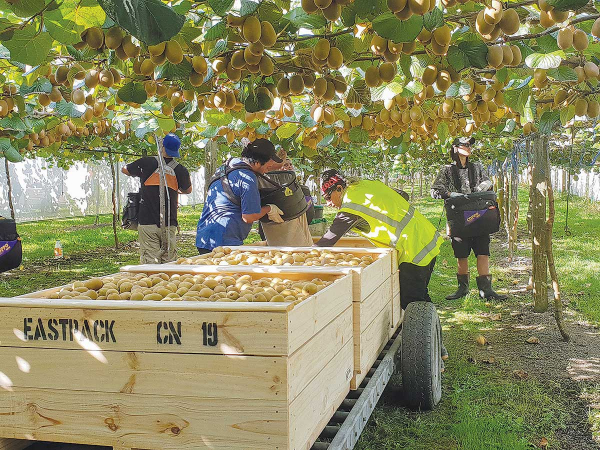 The aim of the new Kiwifruit Breeding Centre (KBC) JV is to bring the best kiwifruit cultivars to the market faster.
Zespri and Plant and Food Research are discussing forming a 50/50 joint venture to fast track the development of breeding new cultivars of kiwifruit.
A proposal is before the boards of both organisations to form a stand-alone Kiwifruit Breeding Centre (KBC). The aim is to build on the present successful plant breeding partnership between the two entities, but bring the best kiwifruit cultivars to the market faster.
The KBC would have its own board comprising representatives of both Zespri and Plant and Food, plus some independent directors. It would have its own CEO and up to about 50 staff – drawn from the two organisations. The plan is in the process of being approved by the respective boards with staff being consulted on the process.
If approved, the new joint venture would see the annual investment in kiwifruit plant breeding almost doubled to $50 million per annum.
Zespri’s innovation and sustainability manager Carol Ward told Rural News the present relationship between the two organisations has worked well with the commercialisation of G3 SunGold and red kiwifruit.
“Now we want to go harder and faster,” she says. “With this proposed joint venture we are looking at bringing the best of global kiwifruit breeding science together with Zespri’s marketing expertise to be able to bring new varieties to market faster.”
Ward says the plant breeding programme will be led by the extensive consumer and market research and intelligence gathered by Zespri. She says it is building a deep understanding of consumers in Europe, Asia and North America.
Ward adds that consumers have given a clear message that a healthy food product is critical to their needs. She says they are looking at when people eat kiwifruit – which often varies between markets. For example, in some cultures people tend to eat kiwifruit at breakfast time.
“One of the significant opportunities we see is to be able to provide kiwi berry variety – a small berry with edible skin that you can pop in your mouth – as more convenient to snack on and tastes delicious.”
Ward says they know that parents are conscious about giving their children healthy products, while at the same time elderly folk want to age in a healthy way and kiwifruit is the ideal food for them.
High on the agenda now for consumers is the sustainability of the product and Ward says that aligns with Zespri’s own values.
“What we know is that consumers who are interested in a healthy diet with good fruit are also really concerned about issues such as pollution, water quality, climate change, global warming, deforestation and biodiversity,” she adds.
“We are now working actively with retailers to assure consumers that we are looking after our staff within the industry and have quality environmental policies. We are also working to remove non-recyclable plastics from our packaging.”
While Zespri’s market intel will help drive the outcome of the breeding programme of the new joint venture, it will also be a strongly science-based programme. The headquarters for KBC will be in Te Puke, but research will be carried out in Motueka in the South Island and also at Plant and Foods facility in Auckland and at Kerikeri in Northland.
Ward says trials will also continue in Italy to make sure any new cultivars can grow in Italian environmental conditions. She says this is in-line with Zespri’s strategic objective to have a 12-month supply operation
More signs of a booming kiwifruit sector.
Blueberries have the potential to become a major horticultural export, earning up to $150 million within the next three to five years.
Westpac NZ has become the first New Zealand bank to receive approval from the Reserve Bank of New Zealand (RBNZ) to secure and leverage kiwifruit growers' Zespri shares.
New Zealand's kiwifruit industry has welcomed Government co-investment in a new five-year programme designed to help growers produce higher yields of premium fruit, with less water, fewer nutrients and reduced environmental impact.
Zespri's sales of kiwifruit for the 2025 season have broken all past records.


Synlait has swung to second-half profit as operations stabilise, but the dairy processor still posted a $75.4m annual loss.

LIC shareholders have elected a new North Island representative to the co-operative's Board, along with five representatives to its Shareholder Reference Group (SRG), following the company's Annual Meeting held in Invercargill.
Farmers across parts of Southland and South Otago are continuing to deal with difficult conditions after a prolonged run of wet weather, with pressure building around feed supply, stock management, pasture damage, farm infrastructure and everyday workloads.
Federated Farmers says it welcomes Labour's commitment to reviewing the Sharemilking Agreements Act, calling on other major parties to do the same.
For Canterbury dairy farmers Sian Meijer and Rick Wobben, wearable technology has become one of their most valuable on-farm tools - helping manage 1850 cows across an expansive, high-performing dairy operation while improving efficiency, mating outcomes and day-to-day decision making.
Fonterra has unveiled its annual results for the 2026 financial year, posting $27 billion in revenue and close to $20 billion returned to New Zealand farmer owners and unit holders.




