NZKGI Responds to Migrant Worker Exploitation Reports
Where any worker in the kiwifruit industry is mistreated, we expect the authorities to take action.
 increase font size
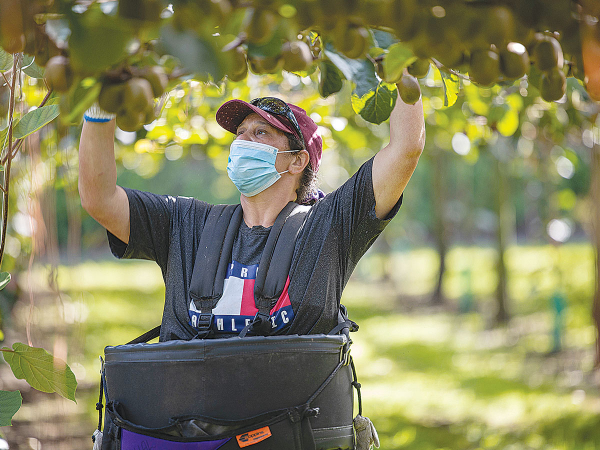 NZ’s kiwifruit industry requires 24,000 seasonal workers for picking and packing roles.
New Zealand's borders are opening again and kiwifruit grower organisation NZKGI wants backpackers coming into the country to help with this year's harvest.
From 12 April, those with temporary work visas and 5,000 international students will be able to travel to New Zealand - assuming they are fully vaccinated - just in time for the beginning of kiwifruit harvest.
NZ's kiwifruit industry requires 24,000 seasonal workers for picking and packing roles. Backpackers traditionally make up around one-quarter of the workforce. This year a record crop of over 190 million trays are forecast to be picked. Before Covid, working holidaymakers accounted for 50,000 of the country's annual international visitors.
In comparison, 2019 saw a record tray count of 147 million, up to 157 million in 2020 and a significant boost of 181.5 million in 2021. According to a Rabobank report, by 2028 NZ's kiwifruit production could reach 300 million trays, with 230 million being a minimum.
As the country's kiwifruit production continues to grow so rapidly, more pickers will be needed to harvest the fruit. Typically, the NZ kiwifruit picking season runs from March until August - with peak harvest from May to July.
NZKGI chief Colin Bond is also encouraging local people to roll up their sleeves.
"Picking (kiwifruit) is a great opportunity for those who like to be in the outdoors, while the packhouse is suited to those who like to have fun in larger teams indoors."
He says with orchards running from the tip of the North Island all the way down the country to the top of the South Island, kiwifruit picking makes a great opportunity for those who want to work and travel.
It is also a fairly lucrative job; almost all NZKGI affiliated packhouses are paying at least $22.75 an hour, while kiwifruit picking is expected to exceed the living wage of $27/hour.
Bond says at a time when cost of living is going up and international travel seems untenable to many, this is a strong incentive for locals to work in orchards.
In 2021, the kiwifruit sector was worth $3.96 billion against NZ's total GDP of $314,929 billion - or roughly 1.26% of the country's economy; the largest horticultural earner and rivalling many other primary sectors.
Where any worker in the kiwifruit industry is mistreated, we expect the authorities to take action.

Kiwifruit growers are watchful but remain optimistic as concerns around the potential effects of the El Niño weather pattern this season.
More signs of a booming kiwifruit sector.
After delivering a strong financial year, rural trader PGG Wrightson says the coming months will depend on customer confidence and weather.
New Zealand growers have always adapted to changing conditions, but one challenge is steadily gaining ground across the horticulture sector: resistance.



National’s much-touted free trade deal with India featured in the Rural Issues Debate at Mystery Creek, Hamilton on Wednesday night.

New Zealand's 2026-27 freshwater fishing season has opened, with anglers encouraged to head to rivers and lakes over the coming days as conditions look favourable across much of the country.
Central Otago District Council (CODC) has voted against a plan to spread treated sewage sludge from Cromwell and Alexandra on farmland near Lauder, a decision Federated Farmers says reflects strong opposition from rural residents.
Pāmu has released its FY26 Integrated Annual Report, reporting a Net Operating Profit of $113 million, more than double the $49 million recorded in FY25.
Meat Industry Association data, released alongside the Red Meat Sector conference in Wellington, shows export value climbing across the US, China, UK and Canada.
Applications are set to open for the 2027 Zanda McDonald Award, a trans-Tasman award recognised for identifying and fast-tracking talented young leaders in agriculture and agribusiness.