MPI Opens $3m Greenhouse Gas Research Funding Round
The Ministry for Primary Industries (MPI) has announced has opened applications for the 2026/27 funding round of the Greenhouse Gas Inventory Research (GHGIR) fund.
 increase font size
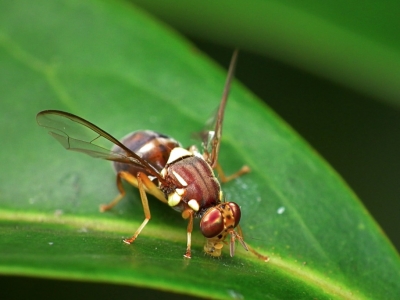 Queensland Fruit Fly.
The Ministry for Primary Industries (MPI) remains confident the isolated population of Queensland fruit fly will be eradicated from Auckland.
Since the first male fruit fly was trapped in Grey Lynn in mid-February, 14 adult flies have been located. The last find was on March 6. The last detection of larvae in fruit collected from the affected area was on March 13.
MPI’s director of response, Veronica Herrera, says this is good news but is not yet an indication that the flies are gone for good.
“We need some months yet to be quite sure this population has been eradicated. We believe that we will be working in the area until at least the end of November and we will need the community’s support for the long haul,” she says.
Herrera says treatments of the five directly affected properties with insecticide spraying are now complete. However, MPI will still need to regularly apply bait to attract and kill any flies present, plus maintain regular trap inspections to make quite sure the flies are gone.
“We are so appreciative of the support of the people in those homes who have had daily visits from our field staff over the past six weeks.
“We are also hugely grateful to the wider community in the Controlled Area who are having fruiting trees in their gardens baited and are having to comply with the restrictions on moving fruit and vegetables.
“It takes some commitment to support this operation. We are pleased that both residents and local businesses realise their support is vital to stopping the spread of the fruit fly and eventually eradicating it.”
As fruit flies go to ground over winter, MPI expects to stop the baiting treatments in the entire Controlled Area sometime around early June. However, to be quite sure of eradication, MPI is likely to need to resume baiting in the springtime.
The intensive network of surveillance traps will stay out over the winter but with less frequent checks. This continued trapping is necessary to verify that the fruit fly is gone.
“This will enable us to assure our international trading partners that New Zealand is once again fruit fly free,” Herrera says.
“Until that time, the controls on the movement of fruit and vegetables outside of the Controlled Area will need to continue to make quite sure any surviving flies are not spread from the area.”
MPI recently made it easier to comply with the rules by allowing customers to purchase fruit and vegetables at certain MPI-approved retailers within the Controlled Area. Produce purchased from these approved retailers can be taken outside of the Controlled Area.
A full list of approved retailers is available at: www.biosecurity.govt.nz
The Ministry for Primary Industries (MPI) has announced has opened applications for the 2026/27 funding round of the Greenhouse Gas Inventory Research (GHGIR) fund.

AMINZ and the Ministry for Primary Industries (MPI) have partnered to develop a new Farm Debt Mediation video series aimed at farmers, creditors, and advisors.
Dairy continues to be the mainstay of the country's primary export earnings.
Don’t worry about it but just be aware - that’s the message from Ministry for Primary Industries (MPI) director-general Ray Smith as the H5N1 strain of bird flu is found in Australia.
OPINION: The latest update from the Ministry for Primary Industries (MPI) on the state of NZ's primary sector paints a positive picturee about its performance over the past 12 months.
New Zealand dairy farmers are set to be the first in the world to receive access to a new digital physical milk pricing tool that enables them to fix the price for their physical milk.
State farmer Pāmu is opening its farm gates this summer in an effort to give the rural sector the opportunity to see how large-scale, multi-system farming is delivering productivity and profitability across New Zealand.
A five-year study has found that the cost of reducing emissions without technology may be significant and unsustainable for Northland dairy farmers.
DairyNZ says Waikato farmers need certainty on Plan Change 1, but they say that certainty must be matched with practical, workable rules and a clear transition that doesn't get ahead of the new resource management system currently under review.
While the Government has moved quickly to make commercial hauliers' lot easier during the current fuel crisis, they appear to be stuck in the creep box when it comes to the agricultural industry.
Waikato farmers have been told that the Government’s new planning system legislation and the region’s Plan Change 1 (PC1) “won’t mesh together very well”.