Federated Farmers Praises Labour's Emissions Tax Backdown
For the first time in a quarter of a century, Federated Farmers has something positive to say about the Labour Party’s climate change policy leading into a general election.
 increase font size
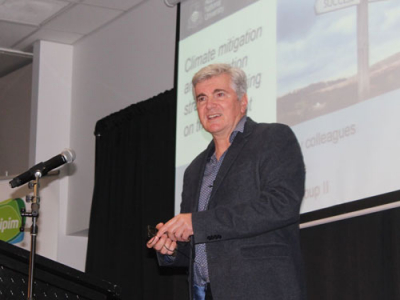 Professor Mark Howden.
Since 1990 New Zealand’s greenhouse gas emissions from agriculture have increased about 20% with industry growth, particularly dairy, but it's not all bad news.
This is the message from Professor Mark Howden, director of the Climate Change Institute at the Australian National University.
As a percentage of the total emissions, agriculture has shrunk. And greenhouse gases emissions (GHG) per unit of food have reduced in NZ by about 30% since 1990, Howden told the NZ Institute of Primary Industry Management (NZIPIM) conference in Hamilton recently.
“That is simply because you are becoming much smarter, much more efficient and more effective in how you use your resources -- increased per animal activity, improved animal husbandry, etc,’’ he says.
But there are signs of increasing room to move to become smarter and better.
Most of the developed world would show a similar drop in greenhouse gases per unit of production, he says.
‘’Particularly in Australia and New Zealand where there is not much government subsidy we are forced to be market responsive; we are tight in our management and inputs versus profits, so we tend to be careful and efficient with our inputs,’’ he says.
“We tend to squeeze down on GHG per unit of production. But the US and Netherlands, where they are highly supported by the government, have also become more efficient per unit because they have cows producing 8000L/day where they used to produce 4000L/day. As they push their system they end up being that much more efficient.’’
The good news story is if you look at greenhouse gases per unit of production, already NZ agriculture is becoming much more efficient.
In terms of emissions as a proportion of total emissions in NZ, even though agricultural emissions have grown, the rest of the economy has grown faster. So the proportion of agriculture emissions has shrunk.
But this does not take into account land use changes in forestry; that is a big negative, he says. If you include land use change, agriculture jumps to 70-80% of the national emissions. In 1990 the carbon sink in forestry was almost equivalent to greenhouse gas emissions. A lot of trees were planted in the 1990s which are now being harvested, so that sink is less than it used to be.
“As greenhouse gas emissions have gone up that sink has come down. But it is still [equal to] about three quarters of NZ’s greenhouse gas emissions.’’
Howden says there are important ways to domestically offset emissions from agriculture but they are not free -- they require action. In addition to planting there is ‘enhanced weathering’ -- crushed basalt spread over the soil where it absorbs carbon dioxide and locks it into the structure. They can increase the fertility and water-holding capacity in poor farm soils.
There is also renewable energy. In Australia, lots of farmers have realised by having wind or solar farms they can earn a stable income and it doesn’t hugely impact their agricultural production in most cases.
Farmers of the future will be spending more time on computers than out in the paddock, he says.
For the first time in a quarter of a century, Federated Farmers has something positive to say about the Labour Party’s climate change policy leading into a general election.
Climate, nature and animal wellbeing make up Fonterra's refreshed sustainability roadmap released last week.
A five-year study has found that the cost of reducing emissions without technology may be significant and unsustainable for Northland dairy farmers.
OPINION: With the winter months officially here, I trust all is well at your place.
OPINION: The global crusade against fossil fuel is gaining momentum in some regions.


Farmer-owned fertiliser company, Ballance Agri Nutrients is welcoming National’s plan to negotiate security agreements with key supplier countries to protect New Zealand-bound products from export restrictions and greater supply chain certainty.

Carrfields has announced the appointment of Stu Hall to the newly created role of chief operating officer, Carrfields Ltd, reflecting the continued growth of their agribusinesses and the need to ensure the company has the leadership capacity and support in place as it pursues the emerging opportunities ahead.
New Zealand's role is not to compete with Indian growers, according to NZ Apples and Pears.
The potato industry is celebrating the success of two rising stars - James Blair, the 2026 Young Grower of the Year and runner-up and innovation award winner, Amber Davy.
Twenty-eight emerging leaders from across the horticulture sector spent two days last month learning valuable skills and connecting with industry experts.
There are five entrants in this year’s Young Horticulturist of the Year, competing in a series of technical, practical, business and leadership challenges.