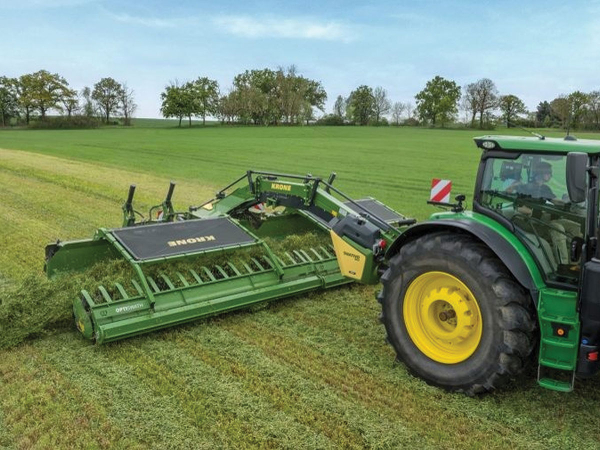
Already known for its extensive range of mowers, tedders and swathers, German manufacture Krone looks to be joining the trend in the swather sector, following the release of its first belt merger, the Swativo T1040 Pro.
Offering a working width of up to 10.4m, the new Swativo will enter a competitive market already populated by manufacturers such as Reiter, Roc Oxbo, Pottinger and Samasz.
The manufacturer notes that while rotary tined swathers are well-suited to grass and straw crops, mergers offer clear advantages with leafy and fragile herbaceous crops such as alfalfa or clovers.
Offering a working width of 8.4m to 10.4m and swath forming widths of 1 to 2m, the existing Easy Flow pickups – configured with five rows of tines –lifts the crop gently and cleanly. Ground pressure of the pickup units is hydraulically adjustable, allowing operators to reduce pressure, particularly in damp soil conditions, helping to prevent damage to the sward.
In addition to the hydraulic suspension system, the pick-ups are also mechanically controlled, using rubberised support wheels, to react quickly to uneven ground.
Crop is transferred via the independently controlled, variably adjusted, star profile FlexFlow rotor and onto the 1200mm wide conveyor belts. Belt speed is also variably adjustable with the belt mounted at a steep angle to prevent tangling so that it conveys the crop directly towards the windrow. All crop transfer elements of the merger are hydraulically driven via the Swativo’s onboard system.
For crop delivery and maximum flexibility, belt delivery direction can be shifted left to right, so the swath can be formed centrally, or to either side of the machine, for single or double swath placement. An automatic belt stop for clean swath ends is standard equipment, while a collection function allows a small volume of crop to be gathered in difficult field areas such as tight corners or short ground.
In-cab operation for all functions and parameters is controlled via ISOBUS, using the current Krone user interface, while also offering predefined harvesting profiles for various conditions, with optional section control automation offering lifting and lowering of the pickup on wedge-shaped fields.
Running on a single axle with air brakes, with 520/50 R17 10 PR tyre equipment, the unit also features a mechanical forced steering system, ensuring improved manoeuvrability in tight corners and accurate tracking. For road transport, the belt units are folded hydraulically to a vertical position and locked automatically, with LED lighting and warning signs, providing travel safety.