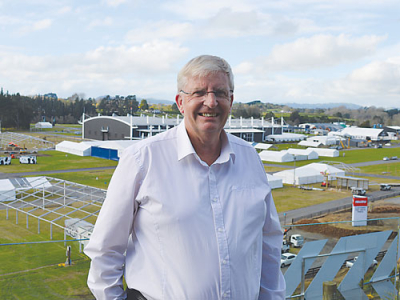
Sustainability remains a key focus for the National Fieldays, says NZ Fieldays Society chief executive Peter Nation.
The Fieldays has a sustainability policy; about 47% of waste from last year’s event went into recycling, edging closer to its target of 55%.
Nation says Fieldays is also trying to reduce its environmental footprint by getting more people to bus to Mystery Creek.
Fieldays last year moved 11,000 people by buses, and more bus services are in place this year. It applied for funding from the Waipa District Council for extra buses but was turned down.
Nation says under the regional council charter, Waipa Council cannot support an event people have to pay to attend. “Unfortunately we got turned down; it’s a shame.”
So Fieldays will pay to run extra buses. “By getting more people travelling to the event by bus we are helping reduce carbon emission,” Nation says.
“Our research shows that only 2.3 people travel per car to Fieldays so our car pooling is not great. We are committed to getting more people to travel by buses -- reducing impact on roads and educating them about using public transport.”
As usual, sites for the Fieldays were sold out well in advance to at least 1100 exhibitors. Some companies are spending a lot to enlarge their sites.
“Companies come to Fieldays to promote their brand, release new technology, sell products and re-invest in existing customers,” Nation says.
“A lot of companies come here and spend money; they don’t sell much but it’s all about getting connections and getting brands in front of 130,000 people.”
When Nation took up the chief executive’s post three years ago, he famously said Fieldays wasn’t about ferris wheels and candy floss.
“We are a technology and innovation show and we have to keep growing to stay relevant; we leave the ferris wheels and candy floss to the A&P shows.”
Highlights year will include international exhibitors including a team of the Czech Republic taking part for the first time; Ireland, South Korea, Australia, the US and UK are also coming. One notable absentee is China; a delegation attended last year.
The careers and education hub launched two years ago continues to attract interest; about 1000 students are pre-booked to attend Fieldays.
This year, the growing health and wellbeing hub has been moved into the education centre; more exhibitors have registered.
The Fieldays kitchen has moved to a new location; 13 celebrity chefs will be in action over the four days. Kitchen sponsor Greenlea Meats will have its master butcher on hand to teach people on prime meat cuts and cooking.
In the Central Village a special wall will feature Fieldays history. Nation hopes this area will become a popular place for selfies.
Ticket price hike
The ticket price will be higher for the 2018 Fieldays.
Anyone aged over 15 will pay a new adult rate of $30/day, versus $25/day last year. Youngsters 5-14 years will pay still $15. Children under five get in free.
Fieldays chief executive Peter Nation says the ticket price hike has been “fairly accepted so far. It’s still a cheap day out.”
He says even with support of sponsors the NZ Fieldays Society has to fund site infrastructure development and the education and health centres, and run buses.