Playing politics?
The Hound's not-so favourite government department, the state-run farmer formerly known as Landcorp, has proven that it is not just a poorly-performing entity but that it can’t even pick winners with the current Government policy.
 increase font size

The introduction of a Capital Gains Tax (CGT) could have a negative impact on farm values, especially in the dairy sector, says Tony Marshall, tax principal with Crowe Horwath's Dunedin office.
"Farming is very capital intensive and as a result, capital growth has been the source of the majority of the value, from the dairy sector in particular," he says.
That capital growth had encouraged investment, particularly in equity syndicates for dairy conversion, says Marshall. Introducing a CGT and thereby reducing net returns could cause investors to reconsider farm syndication in favour of investments that are less influenced by capital return.
Marshall says that what had often been overlooked in the recent debate on whether or not to introduce a CGT, was that New Zealand already had a number of different capital gains taxes, which taxed both realised and, in some cases, unrealised capital gains. The existing CGT regimes taxed property speculation, overseas shares and some other forms of investment.
"And the effectiveness of these existing CGTs is often undermined by the complexity of the legislation surrounding them," he said. "Whether you are a supporter or not of CGT, the key to any tax regime operating effectively is simplicity."
Marshall instanced the example of the Goods and Service Tax (GST).
"GST is a very effective tax because it is very broad in its application and has very few exemptions."
Marshall says he believes a CGT would eventually be enacted, but said it would work best if it was both broad in its application, with very few exemptions, and was created as part of the existing income tax structure, not as a separate tax.
"The less exemptions there are, the easier it will be to enforce, and the fairer it will be to all taxpayers," he says.
Marshall says that his concerns about the CGT recently proposed by the Labour Party were that, while it claimed to be broad-based and comprehensive, it also came with a raft of exemptions.
"It is these exemptions that in my view create a distortion that penalises the productive sector in preference to the non-productive sector," he said.
An exemption for housing created a significant distortion and undermined the purpose of having a CGT. Not only did it incentivise "castle building" for a family home, but it also favoured fast-growing urban areas over rural New Zealand, he says.
"The rate of capital growth is clearly higher in Auckland than it is in Gore — so if you have a choice where to live and work, it would be advantageous to be purchasing a family home in a fast-growing high value area," says Marshall.
"For these reasons the introduction of a CGT needs to be very carefully thought out, the legislation cannot be rushed through, and any exemptions must be few to ensure compliance costs are kept to a minimum," he said. "Those lofty goals are a long way from what we have been presented with so far."
The Hound's not-so favourite government department, the state-run farmer formerly known as Landcorp, has proven that it is not just a poorly-performing entity but that it can’t even pick winners with the current Government policy.

The Government's decision not to proceed with a capital gains tax has been approved by farmers.
Any changes to the tax system should better support the productive dairy sector and not hinder environmental work, says DairyNZ.
A significant number of lifestyle block owners may have to pay a capital gains tax on their family home, warns the Real Estate Institute of NZ.
Federated Farmers says a capital gains tax will add unacceptably high costs and complexity.


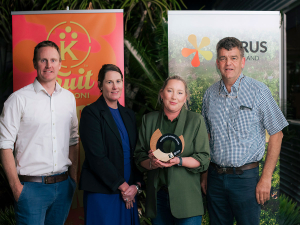
New Zealand's citrus growers were challenged to build their future on the value embedded in their fruit rather than the volume they produce, at Citrus New Zealand's annual gathering in Gisborne on 17 September.

Leading John Deere technicians and apprentices from New Zealand and Australians were recognised at the recent sixth annual JD Technician of the Year Awards, held in Brisbane.
In Dacre, near Invercargill in New Zealand’s South Island, Bruce Dinnington is running a dairy operation unlike any other.
A free online platform aggregating governance vacancies across rural and regional New Zealand has been launched.
Environment Minister Nicola Grigg has announced details of a new rural plastics recycling scheme.
Agricultural drone operators say that a government decision to allow lower-risk drone work without certification won’t lower standards but drive innovation and efficiency.