M.I.A.
OPINION: The previous government spent too much during the Covid-19 pandemic, despite warnings from officials, according to a briefing released by the Treasury.
 increase font size
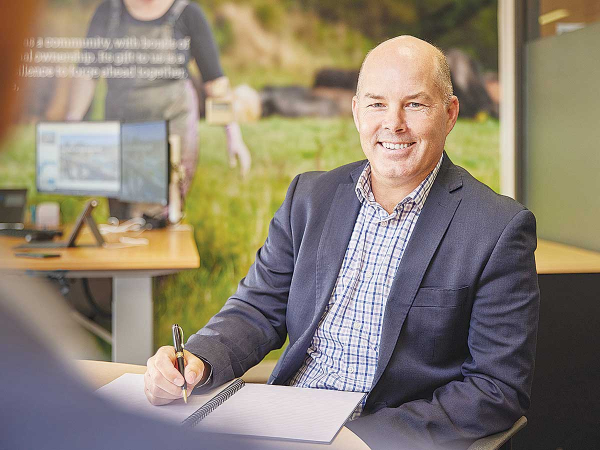 Westland Milk chief executive Richard Wyeth.
Omicron is going to be challenging for the Hokitika-based Westland Milk Products (WMP), according to chief executive Richard Wyeth.
He told Rural News that one of his main challenges as a manager is dealing with a situation where some staff are not vaccinated against Covid-19. Wyeth says while the number of vaccinated staff is relatively high, it is lower than the national average. He says this could potentially rule out mandating all staff to be vaccinated.
Wyeth says as soon as the Government went to the red traffic light setting, WMP continued to run their factory in bubbles and also encouraged those staff who could to work from home. He's also been encouraging staff to get vaccinated.
"The other major step we made was to acquire as many rapid antigen tests as possible because I think getting people back to work will be the main challenge for us," Wyeth told Rural News.
"It will depend on how many staff we may have isolating at home and just the ability to run the plant will be the challenge."
Wyeth says they are discussing the issues of sickness leave at present and says in the past WMP has provided some special leave for staff in certain situations. However, he adds that it's going to be really challenging to manage that. He says one of issues that needs to be sorted with government is to find protocols that allow people to have rapid antigen tests, which will see them back at work sooner.
He says large scale absenteeism through sickness would make it difficult to operate the plant at WMP.
Wyeth says suggestions about bringing people such as drivers out of retirement to fill gaps caused by staff sickness is not as simple as it sounds and creates its own set of challenges.
"This is because you have got to train them and get them back up to speed; it's not a case of just dropping people into a job overnight," he explains.
But the big issue for Wyeth and other primary sector managers is dealing with the conflicting views of staff on vaccinations and ensuring the plants can operate while ensuring that staff are safe and well.
"There are very strong views on both sides and it is a very emotive subject," he told Rural News.
"It is very much about encouraging people to get vaccinated, but I appreciated the fact that some people don't like being told what to do and therein lies the challenge. I have to do what is best for all the staff and the business."
Wyeth says it will be an "interesting year", which is something of an understatement. He just hopes that the Omicron peak comes sooner rather than later and especially not in the peak of the season in October and November.
"As Omicron comes through the country we just need to be adaptable," he told Rural News. "There is a lot of stress on people at the moment as to what it will look like and the uncertainty. As a leader, it is very difficult to provide certainty at the moment because of the nature of the pandemic."
OPINION: The previous government spent too much during the Covid-19 pandemic, despite warnings from officials, according to a briefing released by the Treasury.
OPINION: Labour leader Chris 'Chippy' Hipkins is carrying on the world-class gaslighting of the nation that he and his cohorts started after their disastrous Covid response; now trying to undermine the Covid inquiry to protect his own backside.
OPINION: Did former PM Jacinda Ardern get fawning reviews for her book?
Arguably one of the country's top dairy company's chief executives, Richard Wyeth has abruptly quit Chinese owned Westland Milk Products (WMP)
OPINION: Welcome to the second annual NZ Dairy Expo at Matamata – an event created to bring together the best of the New Zealand dairy industry in a focused, grassroots environment where dairy farmers and rural professionals can meet, talk, compare products, and make smart decisions for their farms.


Testing confirms H5 bird flu in a single northern giant petrel, found dead on a remote Cape Palliser beach in the Wairarapa, says Dr Mary van Andel, the Ministry for Primary Industries' (MPI) Chief Veterinary Officer.

"What's for dinner?" may sound like a simple question, but for many Kiwi parents, answering it has become a job in itself.
Fifty Eight years ago, on the 16th of August 1968, August Claas, the founder of the harvesting company and father of Helmut Claas, personally presented a Claas Senator combine harvester to Scottish farmer John Steven.
New Zealand consumers are paying more for beef mince than ever before, with the average retail price now sitting above $24 per kilogram, according to Rabobank.
State farmer Pamu has delivered its strongest operating result on record.
Four years since it was first detected in New Zealand, researchers and growers now know much more about management of maize pest fall armyworm (FAW).