Research findings published in Europe support the concept of foliar fertilisation or foliar feeding in improving nitrogen use efficiency (NUE) while maintaining pasture productivity.
Trials across four dairy farms in Wales two years ago compared conventional granular nitrogen fertilisers with foliarapplied nitrogen, which is absorbed directly through the leaves. The results showed up to 315% higher NUE in foliar-fed systems, requiring significantly less nitrogen to achieve similar dry matter yields.
Published in the European Innovation Partnership (EIP) Wales, the results point out that dairy farmers can reduce nitrogen fertiliser costs by up to 39% per litre of milk produced, without compromising yield.
The research executive summary notes that most nitrogen fertilisers are applied to grassland systems in solid form. The nutrients are washed into the topsoil by rain and subsequently taken up by the roots of the plants.
However, it says there is another, more direct, method of getting nitrogen into the plant which is through the pores in the leaves.
Previous trials have shown that foliar feeding, applied as a spray, can decrease the amount of nitrogen applied while maintaining dry matter yields,” it says.
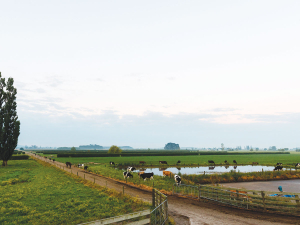
The project tested this theory on four dairy farms in mid and southwest Wales. On each farm, one field – about 6ha - was divided into three plots of equal size and the following fertiliser regimes implemented:
Plot 1: Conventional prilled nitrogen (N) application every 21 days
Plot 2: Foliar feed (a mixture of urea and humic acid) was applied at intervals of 21 days during the grazing season
Plot 3: A control of no nitrogen plots was mostly grazed, but in 2020, additional plots were set up on one of the farms to look at this approach in the context of silage systems.
The first two years’ results suggested that, while in absolute terms, the yields were higher on the conventional fertiliser plots, the NUE – the increase in DM/ kgN applied was much higher in the foliar fed plots. The farmers were interested in whether, by increasing the N concentration in the foliar feed mix, absolute yields could be increased to be comparable with the conventional plots.
Key findings were:
It is possible to achieve comparable yields to the conventional plots using foliar feed systems.
At lower rates of N application, yields were lower in the foliar fed systems. However, the (NUE) was much greater (between 2 and 3 times higher) in foliar fed systems.
Foliar fed systems achieved higher yields in adverse conditions, for example cool and/or dry conditions. This could be because absorption through the leaves was less affected by adverse soil conditions compared to uptake through the roots.
No Regrets
Taranaki farmer Allan Marx embraced foliar feeding seven years ago and doesn't regret it.
Marx was running a conventional style, pasture-based dairy system. Nutrients were applied in solid form using a bulking up to 6 times a year. Application was always weather dependent and particularly urea, was a waste of time without any rain, he points out.
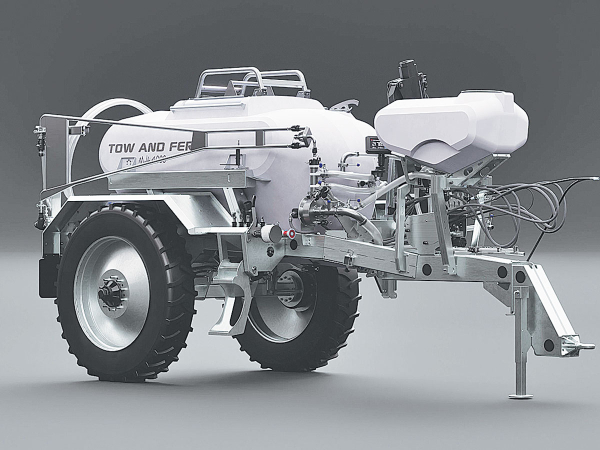
After seeing Tow and Fert machines at National Fieldays, he talked to a friend in the South Island who used a contractor to apply his fertiliser with a Tow and Fert machine. Convinced by the contractor, he went to Metalform in Dannevirke to get a Tow and Fert Multi 4000 built for his farm.
And the results have been seen across the farm in a short space of time.
Marx recalls that with the summer 2018-19 being hot and dry in Taranaki suffered. Milk production graph clearly shows the drop off in the district as the heat took hold. But at Marx's farm, the grass held on a heck of a lot better than surrounding farms meaning he did not have to reduce milking turnaround times to every 16 hours or once a day.
Since taking ownership of the Multi 4000, Marx's farming system has changed significantly. From a largely conventional nutrition system, he has moved into a system that focuses on the ecosystem of the farm, considering the soil, grass and the animal.