New seed drill tech coming
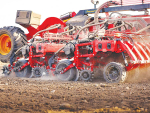
Incorporating Vaderstad's latest seed drill technology, the Proceed V 24, is said to improve precision and increase planting efficiencies for New Zealand farmers and growers from the 2026 season.
 increase font size
 The measurement of seed volume is said to be 99% accurate in rape and 98-99% in cereal seeds with a rate of 250 seeds per second.
Drill specialist Vaderstad has announced a new unique technology called SeedEye.
The system allows farmers to easily set the number of seeds required per square metre without the need for any calibration tests.
The company says counting seeds is far more exact then calculating quantity based on seed weight and it has been developed after customer requests to be able to predict total plants per square metre.
Units comprising six optical sensors illuminated by infra-red light are placed in the seed tubes. As seeds pass the light rays there is a momentary interruption which is recorded by an optical transistor.
The total number of 'breaks' is registered and processed, resulting in a measurement of seed volume said to be 99% accurate in rape and 98-99% in cereal seeds with a rate of 250 seeds per second.
The system is also said to be fully automatic and takes into account any dust or residue that might build up on the sensors.
In practice, the operator sets the desired seed volume per square metre with an iPad and without the need for a conventional style calibration test.
The drill’s radar measures forward speed, and works with the E-Control to continuously achieve the set-point with information being received from the SeedEye sensors. If the operator wishes to change the seeding rate, this is easily done via the iPad and happens instantaneously regardless of the tractor's forward speed.
The system is currently available for Vaderstad Rapid A 400-800S and Rapid A 600-800C drill units.
Incorporating Vaderstad's latest seed drill technology, the Proceed V 24, is said to improve precision and increase planting efficiencies for New Zealand farmers and growers from the 2026 season.
Väderstad’s Rapid A 400-800S, Rapid A 600-800C, Spirit 400C/S and Spirit 600-900C/S pneumatic seed drills have received a new distributor head that can be fitted with motors for all outlets.
Vaderstad's high speed precision planter Tempo is to get two key updates for 2024, with the addition of new electronics to optimise accuracy, alongside the introduction of a liquid fertiliser system.
While many industry watchers have been singing the praises of the latest and greatest innovations at the recent Agritechnica Event, held recently in Germany, agricultural journalists have been deliberating the winners of the Farm Machine of the Year 2024.
Tillage, drilling and planting specialist Vaderstad has expanded its offering with the addition of the new 7.25-metre-wide, XL 725 to the Carrier XL range of disc cultivators – spanning working widths from 4.25 to 12.25 metres.

Dunedin-based company MastaPlex, which provides on-farm mastitis diagnostic platform globally, has named a new independent director.
An independent importer says National’s fertiliser security policy will only work if protects all players.
Nesting birds are behind around $1.2 million worth of tractor fire claims every year, according to rural insurer FMG, which is urging farmers to check under the bonnet before starting work.
Having Ravensdown as the naming rights sponsor of the Canterbury A&P Show demonstrates their confidence in the show as a long-term venture, says Canterbury Agricultural and Pastoral Association (CAPA) board chair Sir David Carter.
OPINION: As election day looms, rural NZ seems to have pressed the pause button – held somewhat in limbo on an orange light.
Will drones be the answer to tackling the problem of wasp and hornet nests high up in trees and other inaccessible places?