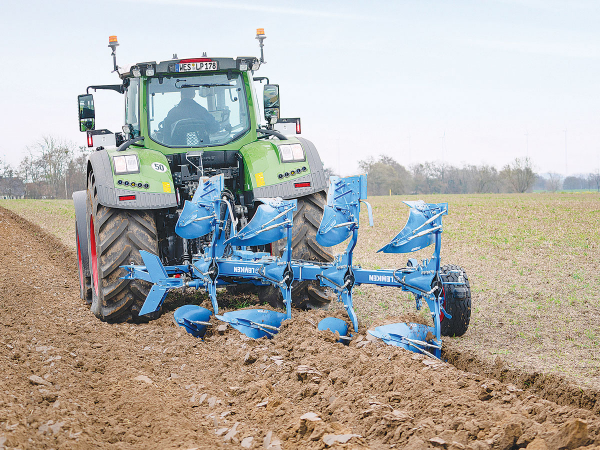
While we keep hearing that the only way forward is the min-till or no-till approach, the reality of modern arable farming is that there is still a place for the plough.
As a young man, far too many years ago, experienced ploughmen told me that the art of setting up a plough – beyond matching furrows – was accurate control of depth. This meant burying any trash by inverting the topsoil, but to also “take” around an inch of subsoil and incorporate in those upper soil layers. This was said to improve drainage, while also increasing the working depth of the topsoil.
It looks like those ploughmen were onto something, following the news that German cultivation specialists Lemken is working on an idea called the Carbon Farming Plough Concept.
Working in collaboration with the Liebniz Centre for Agricultural Landscape Research (ZALF), in that country’s north east, the duo have been working to develop an implement for carbon enrichment in arable soils.
Designed for ameliorative tillage, the idea is to break up compaction and improve the soil. One of the company’s ploughs is fitted with bodies that work at alternating depths to create “wells” below the normal ploughing depth. As the plough moves forwards, the deeper set bodies lift poorer quality soil into the humus-rich topsoil.
ZALF suggests that more than half of the humus introduced in this manner is retained to secure the long-term storage of CO2 in the soil. In the case of the lower soil levels being lifted, an increase in humus is seen in just a few years as a result of the carbon being introduced by the growing crops.
Breaking up the lower soil profile also allows plant roots to penetrate to deeper levels and access water and minerals that were previously unavailable. So much so, that research is showing yield increases of around 5%, even in the first year.
From a practical point of view, it is recommended that the method is repeated diagonally to the main direction of ploughing, after five to ten years. The researchers also suggest that this “carbon farming technology” might also offer up a new income stream to farmers in the shape of CO2 certificates, which could be used to offset any future environmental taxes linked to production.
When paired with Lemken’s iQblue connect module, the Carbon Plough will be capable of collecting site specific and job data, including documenting the position and depth of the “wells” being created.
www.lemken.com