Pöttinger Launches TOP V 6520 C Twin Rotor Rake
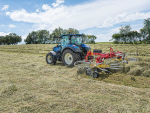
Austrian manufacturer Pottinger has released details of a new compact, linkage-mounted compact twin rotor rake, without a chassis, that is said to deliver impressive manoeuvrability.
 increase font size
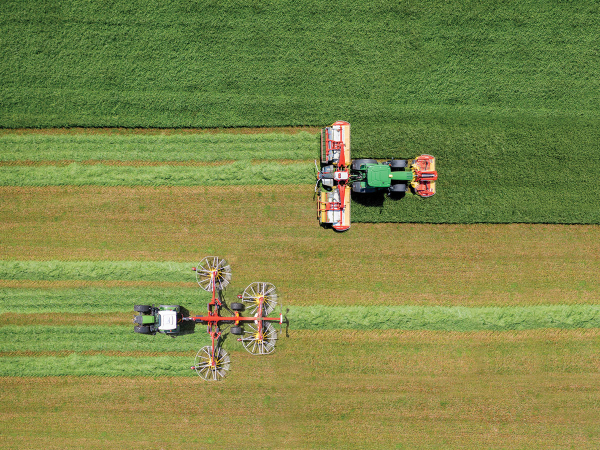 Each swath allows greater forage volumes.
Austrian manufacturer Pöttinger gave a sneak peek of a new automatic swath placement system for the Novacat V 10000 ED/RC Collector mowers at Agritechnica 2025, and recently confirmed that the upgrade will be available for the upcoming European mowing season.
Automatic swath placement ensures that the mower combinations, equipped with a cross-conveyor belt, always deposit the forage correctly.
Merging swaths to one side of the machine - described as intelligent mowing - is more efficient and accomplished much easier than previously.
Said to result in around 40% less raking work, lower fuel consumption, better utilisation of harvesters because of greater forage volumes in each swath, all leading to more cost-effective harvesting.
Additionally, skipping lanes enables larger turning circles at the headland, which helps reduce damage to the sward.
Previously, swath merging systems could be a challenge for the drivers because they required constand switching of the cross-conveyor belt manually.
The new automatic swath placement system automatically switches the cross-conveyor unit depending on which lane is being mowed, resulting in forage always being placed correctly, reducing the risk of operator errors.
In addition, drivers can focus fully on the machine and the surroundings, resulting in reduced fatigue.
If the machine is equipped with Pöttinger Connect, the mowing pattern is intuitively displayed on the map in the HARVEST ASSIST app. This means that the drivers always have a complete overview to efficiently plan their working day.
Austrian manufacturer Pottinger has released details of a new compact, linkage-mounted compact twin rotor rake, without a chassis, that is said to deliver impressive manoeuvrability.

In an era where data offers key information for effective farm management, Pottinger’s Harvest Assist App is a valuable tool for punctual, successful grassland management to support farm operations during harvesting and beyond.
Well known for its innovative seeding solutions, Pöttinger’s new Aerosem M implement-mounted pneumatic seed drill offers a precision metering and rugged coulter system for exact seed placement and prompt and uniform emergence.
While the District Field Days brought with it a welcome dose of sunshine, it also attracted a significant cohort of sitting members from the Beehive – as one might expect in an election year.
After what has been a difficult year with redundancies and factory downsizing, John Deere is reversing course, announcing it will bring 140 employees back to its Waterloo, Iowa operations as demand increases for its 8R and 9R tractors.


Minister of Conservation Hon Tama Potaka has appointed Susan O'Regan as Chair of the Queen Elizabeth II National Trust (QEII) for a three-year term.
Red meat farmers are welcoming Labour’s plan to review the Emissions Trading Scheme and not to campaign on pricing agricultural emissions.
Where any worker in the kiwifruit industry is mistreated, we expect the authorities to take action.
Mid Canterbury Federated Farmers arable chair, Bevan Lill, said Beef + Lamb NZ data indicated that for the last six years, the average arable return on investment was about 0.8% while inflation ran about 4% - so the average arable farm was going backwards at about 3% a year.
Seed and grain companies share the concerns of arable farmers about the viability of their sector, says Seed and Grain New Zealand chief executive Dr Sarah Clark.
The New Zealand Institute of Forestry (NZIF) says unnecessary changes to New Zealand’s Emissions Trading Scheme (NZ ETS) will seriously erode investor confidence and result in significant reductions in forest planting rates.