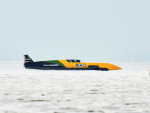
JCB Hydromax Sets 406mph Hydrogen Land Speed Record
JCB has set a new world land speed record of 406.320mph with its hydrogen-powered Hydromax.
 increase font size
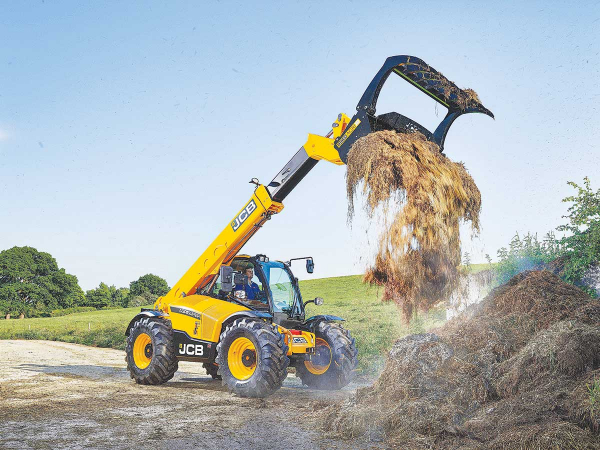 JCB will be on show at the South Island Agricultural Field Days.
JCB and Amazone will be on show at the CLAAS Harvest Centre display at the South Island Agricultural Field Days.
JCB’s new Series III range comprises six models with lift capacities from 3.2 to 5.6 tonnes, a maximum reach of six to nine metres, a new cab and improvements to enhance performance, efficiency, safety, comfort and serviceability,
CLAAS Harvest Centre national sales manager – NZ, Roger Nehoff, notes the new cab features the same adjustable steering column, control layout and function-grouped switches found in JCB Fastrac tractors and wheeled loaders.
“Making it easier for operators to switch from one type of JCB machine to another,” he says.
A seat-mounted joystick and control pod configuration is standard in the Agri Torque Lock4, Agri Super and Agri Pro, while overall the cab is 12% larger and 50% quieter than the previous model.
All models feature the 4.4L JCB EcoMAX engine delivering 109hp or 125hp, while high-spec models are a 4.8L version, delivering 145hp. A range of transmissions includes a four-speed manual, four-speed automatic, torque lock and a combined dual hydrostatic/powershift model.
The Auto Smoothride System engages at speeds over 4km/h, improving load retention and comfort when travelling at speed. Meanwhile, its boom end damping system improves material retention and makes for a smoother work cycle. The high-capacity hydraulic system delivers a flow rate of 140 L/minute for rapid boom operation with hydraulic auxiliary venting activated in-cab or at the headstock for quick and safe attachment changeover.
On the machinery front, AMAZONE Ceus combines a compact disc harrow with a tined cultivator for performance and versatility in all operating conditions.
Available in four working widths from four to seven metres, the new series can perform several processes in a single pass at operating speeds of up to 15 km/h. Nehoff, says the new Ceus series is a true ‘all-in-one’ cultivator.
“Ceus is ideal for farms that need to cultivate at a range of depths, incorporate stubble and prepare seedbeds with just one implement,” he says.
“The front disc section intensively cuts, mixes and incorporates crop residues, as well as creating a finely crumbled soil profile from 5cm to 14cm. The tine section then loosens the deeper soil layers down to 30cm, while importantly, both sections can be adjusted independently.”
The disc section can be raised out of work completely – even with the tines at maximum working depth – reducing pulling power and saving fuel.
Likewise, the tine section can be raised out of work to allow shallow stubble cultivation or set to run just beneath the working depth of the disc harrow when working in heavy conditions.
Individually suspended 510mm serrated discs with the shanks are mounted to the frame via solid rubber mountings. A 17-degree profile and 12.5cm stagger on the front row of discs and 14-degree profile on the rear row is said to produce a perfect cutting and tilling action.
The working depth of the front disc segment is adjusted using the parallelogram guidance, while the penetration intensity can be changed by twisting the disc segment. During operation, the penetration force of the tined section increases the cutting effect of the front discs, helping to achieve the optimum pre-conditions for straw decomposition, germination and crop emergence.
The C-Mix Super tines, set on a 40cm spacing, have a 600kg release force for stone protection, with both the disc and tine sections are followed by a levelling system comprising either smooth or serrated discs or spring tines and a choice of 10 different rollers to suit different operating conditions and soil types.
JCB has set a new world land speed record of 406.320mph with its hydrogen-powered Hydromax.
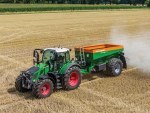
Amazone's ZG-TX combi spreader has been updated with several new features, centred around improved accuracy and easier operation.
While its best known as a manufacturer of construction and agricultural machinery, JCB holds a significant place in the record books, with a surprising mix of land speed records, including the fastest diesel car in 2006, the fastest backhoe loader in 2014 and the fastest tractor in 2019.
With an extensive cultivation portfolio, Amazone entered a new era in tillage 25 years ago when it launched the newly developed Catros in 2001, an innovative design with a high performance, compact, shallow stubble cultivator, initially sold as a three-point linkage mounted implement.
British industrial and agricultural machinery manufacturer JCB has won a £152 million (NZ$348m) military contract with the US Marine Corps as part of the Tractor, Rubber Tired, Articulated-Steering Multi-Purpose (TRAM) vehicle programme.


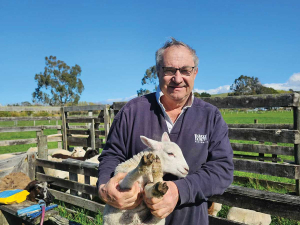
Decades piloting planes has ensured vet and farmer David Hayes is focused on safety. So, after a serious accident while welding on farm, he is sharing his experience so others can learn from it.

Canterbury milk processor, Synlait Milk has confirmed Leon Fung as its chief executive officer.
OPINION: Making it easier to collect rainwater and use it to grow crops and livestock is a no brainer.
As part of its Election 2026 coverage, Rural News asked political parties how they would help pull the arable sector out of the doldrums. Here's what they said:
Farmers are being encouraged to rethink how they manage waste on farm with the launch of ruralwastesorted.co.nz, a new website bringing together practical tips, real farmer experiences and resources.
New Zealand Winegrowers (NZW) is celebrating the India-New Zealand Free Trade Agreement (FTA) coming into force today, bringing New Zealand wine improved access to one of the world’s fastest-growing economies.