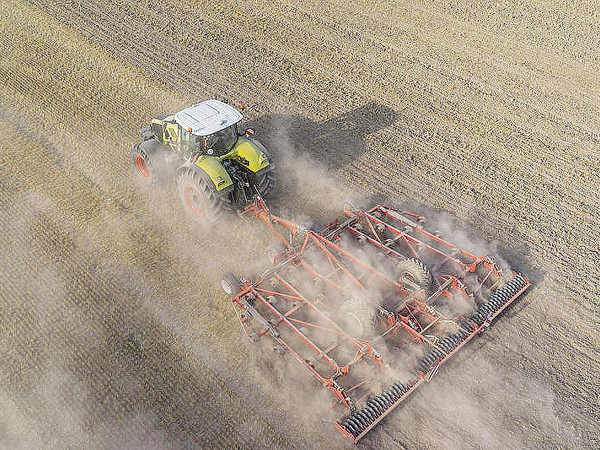
Introduced in 2020, the Kverneland Turbo T cultivator comes in 6.5 and 8 metre working widths.
Both trailed machines carry five banks of tines and fold to a manageable 3m transport width.
Aimed at cropping farmers and vegetable growers, the Turbo T is said to be particularly useful for dealing with maize stubbles or fodder beet residues. The machine provides 725mm of under-frame clearance, combined with a 190mm leg spacing.
Carrying 31 or 44 tines respectively, the 6500 and 8000 machines are equipped with the well known Kverneland Triflex 400 tines – with its instantly-recognisable green, maintenance-free, leaf spring configuration.
Offering up to 400kg resistance, the layout can operate at working depths of 3-20cm.
For the 2021 season, purchasers can also specify the Reflex tine assembly, aimed particularly at users in the North Island where there is more ploughing, to give the option of either ripping into stubble or working with wider points on ploughed land.
Distributor, Power Farming, reports that the machine is highly versatile in the spring ahead of maize planting, going deeper to help promote root growth. Likewise, post cereal harvesting, it can be used at high speed at shallower depths to promote weed and volunteer germination – with high work rates.
The machine gives a “full cut” across the whole working width, with a combination of forward speed and resonance within the leg delivers good mixing of trash and organic matter. It also has the added benefit of a level finish.
Power requirement is low at around 35-40hp per working metre, with routine maintenance also kept low by the use of high-grade steel and sealed bearing assemblies. For high daily outputs, the machines have a maximum horsepower rating of 450hp.
The standard point, a 60mm knock-on fitting, is suitable for working at depth to ensure full soil movement through the profile, while also offering time saving during replacement.
For shallower operations or lighter soil types, the machine’s options include a 150mm point or the “Tiger” point – specifically designed for stony soils.
Rear of the tines, a levelling element consists of a revolving disc configuration.
This is suited to all conditions, particularly heavy land and high straw volumes, before final consolidation and finishing is carried out by the rear-mounted, 565mm diameter Actipacker.
Ease of use is taken care of with hydraulic cylinders and spacers for depth control. The cultivator also comes with a separate, manually-adjusted crank handle for the levelling element.
When the working depth is adjusted, a parallelogram linkage ensures the levelling system is also adjusted to maintain the quality of work.