B+LNZ Urges Farmers to Graze Lucerne Hard Before Winter Weed Control
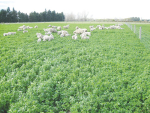
Beef + Lamb New Zealand is reminding farmers with lucerne stands to graze them hard over the next few weeks in preparation for a winter weed control programme.
 increase font size
 Dr Ronny Groenteman, Landcare Research biocontrol scientist.
Biocontrol measures that helped Australian farmers control a serious dryland weed for 20 years may at last benefit New Zealand.
The measure is enabled by research funding from the Ministry for Primary Industry’s Sustainable Farming Fund.
Horehound is an unpalatable and bitter shrub, part of the mint family, which invades dryland pastures. Described as the Achilles heel of dryland lucerne, horehound is a major pest of high country Merino farming.
Of little nutritional value, it competes with lucerne, and its infestations tend to worsen if it is sprayed. If it takes over to the point where stock are forced to eat it, it taints the meat, and its seed burrs contaminate and devalue the wool.
In Australia, however, horehound has been kept largely in check by two moths introduced in the 1990s -- one attacking the green tops and one attacking the root.
Landcare Research insect ecologist Dr Ronny Groenteman says the science community here “hadn’t had any signals” from farmers that horehound was a problem, while farmers struggled on unaware of the Australian solution.
With a recent grant of $285,450 from the SFF, Groenteman is now managing a project which, accelerated by the Australian experience, could see the two biocontrol moth species released here in as little as two years.
She credits Gavin ‘Snow’ Loxton, of Sawdon Station, Tekapo, for bringing the problem to light, forming the Horehound Biocontrol Group to co-ordinate the effort.
Loxton says he had been battling horehound for a long time before realising, on a study trip to Europe, that biological checks had to exist.
“I was looking around for this horehound, seeing as it came from Europe. I stomped all over the hills, all over Switzerland, and couldn’t find a single plant. We got all these problem plants from Europe, but they’re not such a problem over there.”
He says a survey of NZ farmers found the problem was worse than expected, especially in North Canterbury and Central Otago.
“I went to a place three weeks ago where it looked as though he’d actually drilled horehound in the paddock. There was more horehound than there was lucerne.”
Groenteman says they still want farmers to participate in the survey. It is hard to find even one Merino farm free of horehound, and it is now becoming a problem on equestrian properties.
Groenteman says horehound competes with lucerne particularly in dry years, because of its long tap root. Lucerne is also sensitive to the herbicides used, and horehound is usually the first thing to come back on any bare patch.
“The habitat you create by controlling horehound chemically is favourable to more horehound infestation. It creates bare habitat that horehound then takes over,” she explains.
However, Groenteman expects bringing the moths to New Zealand with relative ease because of the Australian experience. “If they hadn’t done the work we would have had to go to the native range of the weed – Europe and the Mediterranean -- and look at what’s attacking it there. But since the Australians have done the work for us we don’t have to do that and we can start with what they already use.”
She says they will have to ensure the moths do not attack anything of native or economic value, but on preliminary knowledge she believes host specificity would be high and that the few native mints were sufficiently distantly related to horehound that the moths would not be interested.
Beef + Lamb New Zealand is reminding farmers with lucerne stands to graze them hard over the next few weeks in preparation for a winter weed control programme.

OPINION: This old mutt has questioned before the objectivity of research produced by Landcare Research on regenerative agriculture (RA).
NZ's latest farming fad - regenerative agriculture (RA) - is getting a boost with more taxpayer funded backing.
A coordinated national research project has been launched to combat six of New Zealand’s most invasive weeds through biocontrol.
With some farmers transitioning to regenerative agriculture in New Zealand, there is an urgent need for clarity about what regenerative agriculture is in New Zealand and for scientific testing of its claimed benefits, says Landcare Research.



Now in its fourth year, the 2026 Fencing Industry Awards, formed part of the proceedings of the FCANZ Conference, held in Nelson during August.

DairyNZ deputy chair Cameron Henderson has been re-appointed unopposed for another term.
OPINION: The stats speak for themselves.
Farms across the upper North Island are trialling different pasture mixes as part of a research programme that aims to build greater resilience into farming systems.
Election years are always a concerning time for farmers, according to DairyNZ chair Tracy Brown.
The Ballance Farm Environment Awards are coming to the West Coast of the South Island.