International Day of Rural Women: Two DairyNZ Farmers’ Stories
Today, 15 October, is the International Day of Rural Women, which recognises rural women’s contribution to farming, communities and the environment.
 increase font size
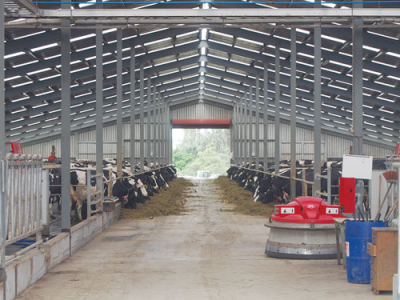 A view inside in the robotic cow shed on the Moa Flat Dairy farm at Cave run by Alex Ulrich.
Correct design is crucial to the success of indoor barn dairy farming, says farm consultant Keith Woodford.
Key elements are the correct sizing of cow beds, feeding systems and ventilation.
“Kiwi farmers sometimes go wrong with their DIY designs which ignore 50 years of overseas expertise relating to cow behaviour, cow movement, and air movement,” he explains.
“It is important to get it right first time, as solving the problems of a poorly designed barn are difficult without a bulldozer.”
Woodford was speaking during a visit to the Moa Flat dairy farm at Cave, South Canterbury, a field trips for attendees at the recent Grassland Association Conference.
Moa Flat can accommodate up to 300 cows under an indoor free-stall voluntary robotic milking system, with feed grown on the remainder of the 150ha (110ha irrigated) property.
It is run by Alex Ulrich with feed and grazing support from nearby Rock Farm, run by his parents Herstall and Aly Ulrich. Both farms featured in the field trip.
Alex Ulrich says his indoor cows get a fixed ration of the same mix in the feeding bunker and at the robots – lucerne, maize, grass, barley, canola and fodder beet.
“We’re sitting at about 9.5kgDM/kgMS produced. DairyNZ figures suggest that 12-14kgDM is average. So it’s very efficient milk they’re doing inside.”
Moa Flat milks year-round, calving and AI occurring every week. About 60 dry cows graze outside and heifers are grown out on Rock Farm and returned to Moa Flat pre-calving.
Lucerne features heavily in the farm’s feeding plans, as it did at the conference itself, with several papers on lucerne management.
Herstall Ulrich says lucerne used to be grown mainly for conserving supplementary feed, rather than grazing. Farmers moved away from it because of losses to aphids, sitona weevil and various fungal diseases, but are now returning to lucerne with the availability of more pest-resistant strains.
“We’re probably sticking our necks out a little in that respect. Others have been in the forefront of growing lucerne for grazing as opposed to just conserving feed.”
Moa Flat aims for self-sufficiency in feed, and lucerne is “a core component of the diet,” Herstall Ulrich says.
Moa Flat has about 100ha in forage for harvest, 22ha in maize and the rest in lucerne or a lucerne/grass mix. The lucerne is cut and baled about six times a year, yielding about 3000kgDM/cut. The farm runs all its own harvesting machinery.
Addressing the economics of barn dairy systems, Woodford says a key issue is off-season premiums paid for winter milk.
He says the future of barn systems will depend on leaching rules and whether NZ moves to consumer-focussed value-added products requiring non-seasonal production.
NZ needs to research integrated feed systems specific to our conditions, and needs rural professionals trained in barn-farming systems, he said.
Another speaker at the Moa Flat visit was Nicole Phillips, of Irricon Resource Solutions, Ashburton, who said a housed dairy unit was difficult to model within Overseer, which “appears to assume” a high water use, similar to a conventional shed.
“In reality, a much lower volume of water is used, as only the robotic milking area is hosed down. The barn is cleared with scrapers,” Phillips says.
“This assumption, in my opinion, leads Overseer to overestimate effluent generated and applied to land, potentially inflating the applied nitrogen figures from effluent.”
Today, 15 October, is the International Day of Rural Women, which recognises rural women’s contribution to farming, communities and the environment.
The first major update to the Dairy Cattle Code of Welfare in more than a decade has been released, marking what DairyNZ describes as an important step in ensuring animal welfare standards continue to evolve alongside scientific evidence and on-farm realities.
Have a plan in place for your cows and staff.
DairyNZ deputy chair Cameron Henderson has been re-appointed unopposed for another term.
OPINION: The stats speak for themselves.



Federated Farmers has welcomed new rural policies released by ACT, saying they align closely with its own election priorities.

Rural Contractors NZ says proposed changes to land transport rules for agricultural vehicles are a welcome response by the Government to out of date regulations which have seen members hit with huge fines.
Alliance is calling for final applications for its 2027 Graduate Programme, with applications closing on Sunday 25 October.
Decades piloting planes has ensured vet and farmer David Hayes is focused on safety. So, after a serious accident while welding on farm, he is sharing his experience so others can learn from it.
Canterbury milk processor, Synlait Milk has confirmed Leon Fung as its chief executive officer.
OPINION: Making it easier to collect rainwater and use it to grow crops and livestock is a no brainer.




