Pest confirmed on West Coast
A tropical insect pest with a big appetite for corn has been identified on the West Coast, the first time it has been found in the South Island.
 increase font size
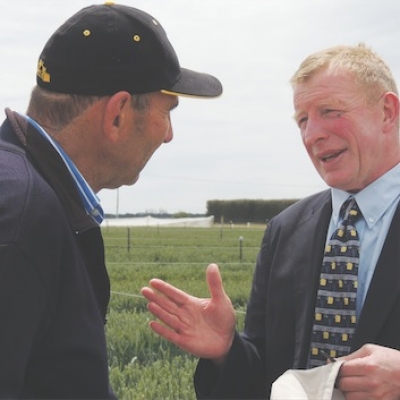 UK agronomist Patrick Stephenson with local grower.
Beware sowing wheat super early, but standard plant populations may need a rethink to push yields to new levels, leading UK agronomist Patrick Stephens told visitors at Crops 2014.
The reason many growers in the UK sow wheat in the equivalent of early March or even late February isn’t to increase yields of those early paddocks, but to reduce the risk of not getting all wheats sown if the weather turns to custard, he explained. “It’s to maximise potential across all the crop.”
Going too early could “break the system”, he warned, producing excessive canopy where disease “festers” resulting in increased spray costs yet lower yields.
With fewer new fungicides coming to market, using other tools such as cultivar resistance, sowing date and possibly cultivar blends, could be necessary to increase yields while reducing the risk of diseases developing resistance to fungicides.
However, there’s a trend for the highest yielding varieties to have high fungicide responses, suggesting more disease resistant cultivars may use some of the light energy they capture to fight disease leaving less to go into yield.
Stephenson said several studies show average wheat yields across Europe have stagnated since the 1990s so work is underway to see why and how a rising trend might be resumed.
Putting phosphate fertiliser “down the spout” at drilling with seed, once a common practice but largely abandoned in the interests of getting larger areas sown faster, could be worth a revisit as trials have shown responses even at relatively high soil P levels.
Similarly, soil nitrogen supply (SNS) tests provide useful figures to calculate fertiliser inputs up to a point, but at high SNS readings growers shouldn’t rely on the soil providing all the crop’s needs, even though the SNS level may appear to have enough nitrogen in it for the target yield.
The industry standard 450 ears/m2 crop population may also need a rethink as a UK project called the Yield Enhancement Network has found the highest yielding crops today have about 700 ears/m2.
However, Stephenson warned growers not to read too much into the use of eight trace element applications on the highest yielding crop. “They spent about £360/ha more, including £193 on traces, and it yielded 0.1t/ha more…. There are a lot of other things in play before we get to snake oil.”
A tropical insect pest with a big appetite for corn has been identified on the West Coast, the first time it has been found in the South Island.

New Zealand's arable farmers have been challenged to do things differently.
‘Wet’ sums up the 2018-19 grain season for Canterbury, says the Foundation for Arable Research (FAR) research manager for cereals, Rob Craigie.
Federated Farmers and other arable industry groups are working with MPI following the detection of blackgrass seeds.
FOUNDATION FOR Arable Research chief executive Nick Pyke says over 600 people attended the organisation’s flagship biennial event Crops 2014 – more than any previous FAR industry event.


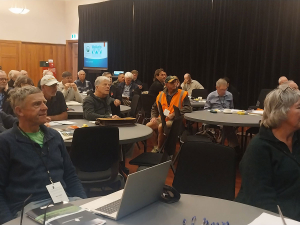
Dougal Morrison has been elected as the new President of the New Zealand Farm Forestry Association (NZFFA).
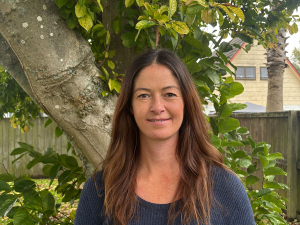
Perrin Ag has appointed Vicky Ferris as its new Hawke's Bay consultant.
The New Zealand National Fieldays Society is encouraging teachers to register school groups for the 2026 National Fieldays, set to be held at Mystery Creek Events Centre from 10-13 June.
The appointment of Richard Allen as Fonterra's new chief executive signals execution, not strategy, according to agribusiness expert Dr Nic Lees.
Potatoes New Zealand has become much more than a grower body, according to Pukekohe grower Bharat Bhana.
The country's kiwifruit growers seem to have escaped much of the predicted wrath of Cyclone Vaianu which hit the east coast of the North Island this month.