Fall Armyworm in NZ Maize: Four Years of Research
Four years since it was first detected in New Zealand, researchers and growers now know much more about management of maize pest fall armyworm (FAW).




 increase font size
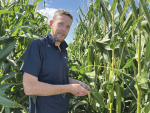
 FAR’s Ivan Lawrie says all maize growers should be inspecting their crops regularly for any signs of Fall Armyworm.
A tropical insect pest with a big appetite for corn has been identified on the West Coast, the first time it has been found in the South Island.
With previous confirmed finds only in the North Island, Fall Armyworm was confirmed in a paddock of maize, near Hokitika, with two other finds in the region in early January. This brings the total number of finds in New Zealand since September 2022 to 56.
Fall Armyworm is the name commonly attributed to the larval stage of the moth Spodoptera frugiperda, native to the Americas. However, with its strong flight abilities (up to 500km in a lifetime) an accidental introduction to China has seen a rapid spread in range.
Its life cycle has an egg stage of 2-4 days, usually in clusters of 100-200, up to six larval stages lasting for a total of 24-30 days, a pupal stage and an adult moth stage. The larval stages can feed on dozens of economic crops such as lettuce, onions and especially corn, causing widespread damage.
Ivan Lawrie, business operations manager for the Foundation for Arable Research (FAR), says the evidence suggests several maize crops are affected.
At the Hokitika site, maize was at its final leaf stages and the larvae present were large, suggesting that some had already dropped to begin pupation. More than 25% of plants were affected at the whorl stage.
“We are very grateful to the grower and local rep for the swift reporting which raised this important alert,” Lawrie says.
“All Kiwi maize growers should be inspecting crops regularly. Control is easier and more effective if damage is identified at the early stages before the larvae moves into the plant whorl.”
The industry is working with the government on how to respond, with members of the FAR/Seed and Grain Readiness and Response (SGRR) team along with Dr Scott Hardwick from AgResearch visiting Hokitika to assess crop damage and the efficacy of control. The insecticide Sparta (spinetoram 120g/L) is now on label for ground applications to combat fall armyworm in corn crops.
Corn earworm (Helicoverpa armigera) was also present in the crop. As the pests can look similar, if growers have any doubts they should photograph different specimens and send multiple pictures in to the Ministry for Primary Industries (MPI).
More than 200 FAW traps deployed by the response group continue to be assessed throughout New Zealand. All findings must be reported to MPI.
Lawrie says there are no negative consequences to growers reporting, as crops where the pest is confirmed will not be destroyed or put under controls.
He says farmers are urged to continue to check traps and report online.
“People should be actively scouting for caterpillars on the crop – and not just relying on the moth catches from traps.”
Response contacts: email: This email address is being protected from spambots. You need JavaScript enabled to view it. or ph 0800 80 99 66
Four years since it was first detected in New Zealand, researchers and growers now know much more about management of maize pest fall armyworm (FAW).

New import standards could put New Zealand’s blueberry industry and the wider horticulture industry at risk.
Biosecurity New Zealand says Kiwis should continue to keep an eye out for yellow-legged hornets (Vespa velutina) over the holiday season.
Biosecurity New Zealand is intensifying its campaign to locate and eliminate the invasive yellow-legged hornet, following confirmed detections on Auckland's North Shore.
Maize and sweetcorn pest fall armyworm has defied initial assessments regarding its ability to survive over winter in some parts of New Zealand.



The Royal New Zealand College of General Practitioners (the College) and Hauora Taiwhenua Rural Health Network are calling for investment in a proposed new training pathway for rural GPs, warning that many rural practices are struggling to recruit while a large share of the existing workforce nears retirement.
Federated Farmers has called on Central Otago District Council (CODC) to drop or vote down a plan to truck sludge from Alexandra and Cromwell to farmland near Lauder, warning it would compound an "outrageous" situation created by a separate council's decision weeks earlier.
Synlait has swung to second-half profit as operations stabilise, but the dairy processor still posted a $75.4m annual loss.
LIC shareholders have elected a new North Island representative to the co-operative's Board, along with five representatives to its Shareholder Reference Group (SRG), following the company's Annual Meeting held in Invercargill.
Farmers across parts of Southland and South Otago are continuing to deal with difficult conditions after a prolonged run of wet weather, with pressure building around feed supply, stock management, pasture damage, farm infrastructure and everyday workloads.
Federated Farmers says it welcomes Labour's commitment to reviewing the Sharemilking Agreements Act, calling on other major parties to do the same.





OPINION: The same mainstream media muppets that brought you Jacindamania in 2017 have been flat out pimping for the Opportunities…
OPINION: Your old mate reckons the atrocious way farmers in the UK are treated by their lords and masters in…