With reports that sales are down significantly, no doubt driven by higher cost and lower returns, it follows that accurate spreading of any product being used is a must.
That accuracy needs to ensure the product is spread evenly and at the right rate across the whole spreader width. While we are in the depths of winter, hopefully spring isn't too far away, so it might be a good time to start thinking about application.
To achieve optimum benefit, suppliers recommend that a broadspectrum soil analysis is used in conjunction with a nutrient management plan to help decide which fertiliser is the most appropriate for a crop’s needs.
Check that all the fertiliser to be applied comes from the same batch, particularly if delivered on several dates or if you have a carryover of old stock. Sometimes product can come from different factories, meaning two batches of the same product might have different spread settings and may need to be tested separately.
The fertiliser needs to have consistent characteristics to achieve an even spread, so because product can degrade with age, old versus new stock may need different settings.
The fertiliser needs to have consistent characteristics to achieve an even spread, so because product can degrade with age, old versus new stock may need different settings.
The timing of applications should centre around the needs of the crop, with trial data showing that crops benefit from a spring application of N, P, K and S as this is when their demand for these major nutrients is at its highest.
An eye on the weather is a must, especially if spreading lighter materials, with the best rule of thumb being, “if it’s too windy to spray, don’t spread either!”
On humid days, fertiliser can absorb moisture that will affect flow rates, particularly in the case of sulphur products, with building up on the spreader vanes quicker than in dry conditions.
Before and during spreading operations, regularly check the spreader for wear and tear as it will impact spread patterns. Be sure to replace parts where appropriate and follow the manufacturer’s maintenance advice.
On a practical level, ask your tractor dealer to check the PTO speed read-out on the tractor screen, relative to the actual speed at the PTO shaft. In many cases, often because of calibration issues at the factory, the readout is not the same.
Pay attention to the spreader vanes and clean each time, before refilling your hopper. Over time, sulphur containing fertilisers are known to leave deposits on the spreader vanes which can create a build-up or cause blockages, leading to uneven spreading. Using a WD40-type product and rag is ideal to clean the area vanes.
The correct setting of a spreader is determined by the physical properties of the fertiliser, with regards to particle size distribution, bulk density and flow rate which all influence the setting and the eventual accuracy of application. Manufacturer’s tables are a guide only, based on tests under ideal conditions in test stations, and give information on how to set the spreader for optimum, even spreading at the desired application rate (kg/ha) and at a specific working width.
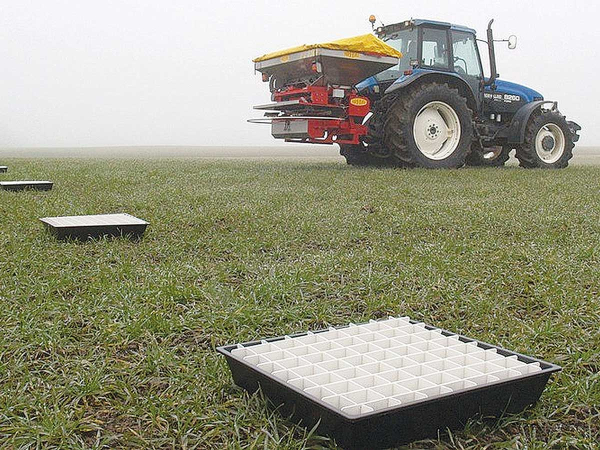
To achieve optimum spreading, you should perform a tray test using your particular combination of spreader and fertiliser, with a separate test conducted for different fertiliser.
As a starting point, machine height needs to be set to ensure the disc or spout on a mounted spreader is at the correct height above crop, as recommended by the manufacturer’s guide.
Other points to look out for include forward speed, which plays an important role in achieving a constant application rate, so always travel at the recommended forward speed to avoid uneven spread and alterations in rate.
The manufacturer’s handbook will give this information for the type of fertiliser to be used and its recommended spreading widths. At headlands, leave enough space for two bouts around the field, using the headland disc or border device supplied with the machine. Alternatively, many machines are now using the latest technology to switch application on or off as the headland mark is passed, avoiding double dosing or indeed misses.