Arable Sector Costs Are the Biggest Problem, Says FAR
Flat pricing in the face of significant increases in costs is the greatest problem facing the arable sector, says Foundation for Arable Research (FAR) chief executive Dr Scott Champion.
 increase font size
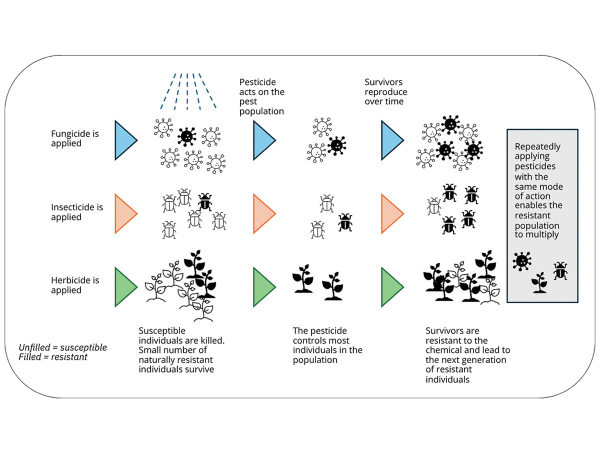 A graph showing how pesticide resistance develops.
Growers and farmers are being encouraged to have an important conversation before the coming season starts: how to prolong the effectiveness of the crop protection tools they rely on.
Keep What Works Working is an industry-wide campaign led by the A Lighter Touch programme. It aims to raise awareness of resistance management and encourage growers to discuss their plans with crop protection advisers before spray programmes are finalised. The resistance management can have a significant impact on how long valuable agrichemical tools remain effective.
Growers are already experiencing the impact of resistance through the loss of valuable crop protection products. In recent years, however, the increasing pace at which resistance is developing has heightened concerns that the problem will only worsen, underscoring the need for the industry to act collectively.
Resistance occurs when pests, diseases or weeds become less sensitive to pesticides, reducing the effectiveness of products that once provided reliable control. Over time, repeated use of products with the same mode of action can increase the likelihood of resistance developing, leaving growers with fewer options to manage production risks.
A Lighter Touch Programme director Livia Esterhazy says resistance management should be viewed as an investment in the future resilience of farming and growing businesses.
"Growers rely on a relatively limited number of crop protection tools to manage pests, diseases and weeds. Once resistance develops those tools become progressively less effective and, in some cases, can eventually fail altogether," Esterhazy says.
"The good news is there are actions growers can take that can make a difference. By having a conversation with their adviser before the season starts, they can take practical steps that help protect the tools they depend on today, while preserving options for the future.”
The campaign spans the horticulture, viticulture and arable sectors, although its message is equally relevant to pastoral farming systems where agrichemicals are also used. It has been developed in consultation with industry to address the ever-growing threat of developing resistance.
The economic case for action is also becoming increasingly clear. Analysis undertaken by the New Zealand Institute of Economic Research (NZIER) found that reduced resistance management could impose significant costs on New Zealand’s production systems over time.
Scenario modelling over a 10-year horizon estimated potential losses ranging from $74 million under moderate impact scenarios through to more than $1.26 billion in severe scenarios where resistance problems become widespread.
Flat pricing in the face of significant increases in costs is the greatest problem facing the arable sector, says Foundation for Arable Research (FAR) chief executive Dr Scott Champion.
Where any worker in the kiwifruit industry is mistreated, we expect the authorities to take action.
OPINION: Warning bells are ringing in the arable sector.
Kiwifruit growers are watchful but remain optimistic as concerns around the potential effects of the El Niño weather pattern this season.
Mid Canterbury Federated Farmers arable chair, Bevan Lill, said Beef + Lamb NZ data indicated that for the last six years, the average arable return on investment was about 0.8% while inflation ran about 4% - so the average arable farm was going backwards at about 3% a year.


Federated Farmers has welcomed new rural policies released by ACT, saying they align closely with its own election priorities.

Rural Contractors NZ says proposed changes to land transport rules for agricultural vehicles are a welcome response by the Government to out of date regulations which have seen members hit with huge fines.
Alliance is calling for final applications for its 2027 Graduate Programme, with applications closing on Sunday 25 October.
Decades piloting planes has ensured vet and farmer David Hayes is focused on safety. So, after a serious accident while welding on farm, he is sharing his experience so others can learn from it.
Canterbury milk processor, Synlait Milk has confirmed Leon Fung as its chief executive officer.
OPINION: Making it easier to collect rainwater and use it to grow crops and livestock is a no brainer.