PC1 Pause Looms as Coalition Targets Waikato Farm Rules
A pause on Waikato Regional Council's (WRC) plan change that sets new freshwater rules for farming could be announced in the coming weeks.
 increase font size
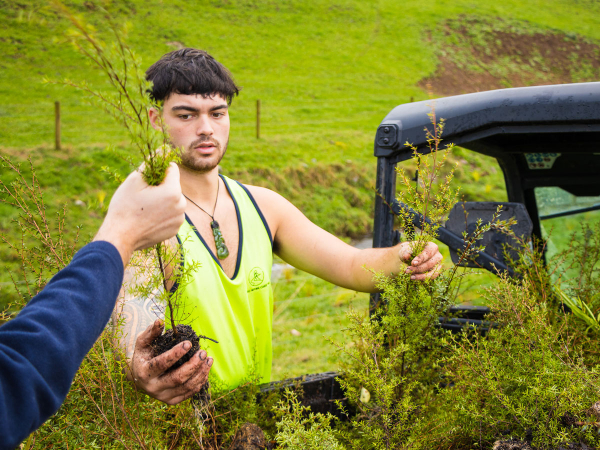 Trey Newsome from Pūnui River Care working on the council’s two-year Clean Streams 2020 project, which was funded $1.998 million by MPI’s One Billion Trees project to enable landowners in priority catchments across the region, who permanently retire a stream, wetland or seep from grazing, have the retired area planted in native plants at no cost to them. Photo Credit: Waikato Regional Council
Waikato landowners, supported by Waikato Regional Council, have retired the equivalent of 21 average-sized farms of unproductive land and planted over 3 million trees in the past five years.
The council’s Integrated Catchment Management directorate manages catchments in partnership with landowners to reduce soil erosion, flooding and the amount of sediment getting into waterways, and to improve water quality, river stability and river environments.
One way it does this is to help fund the costs of riparian and hill country fencing and planting.
This voluntary catchment and river restoration work is funded in different ways throughout the region, with funding coming from rates collected and/or by the council applying for funding for various work programmes from other organisations such as Waikato River Authority, the Ministry for the Environment, the Ministry for Primary Industries, the Ministry of Business, Innovation and Employment and the Waikato Catchment Enhancement Trust.
The amount of funding available to landowners depends on whether landowners live in an identified priority catchment or whether the council has secured additional funding for work programmes outside business as usual. It ranges from 35% of costs to 100%, depending on the type of work and funding available, and landowners are able to use their contribution as work in kind.
Waikato and West Coast catchments manager Grant Blackie says the council has financially assisted 1,823 landowners in the past five years, with 80% of the work funded undertaken in prioritised catchments.
“In the Waipā Zone, for example, we have catchments that are predominantly farmland and highly modified which deliver high loads of the sediment to the Waipa River, so we’ve had extra funding available for those landowners through the Waikato River Authority and MPI’s Hill Country Erosion Fund and One Billion Trees,” he says.
“Landowners are doing a phenomenal job taking care of their land and unfortunately we always have more landowners wanting to work with us than we have funding available and there are large areas of the region outside of our priority catchments where only very limited funding is available.”
Blackie says that in the past five years, landowners have retired 5,777ha of land.
“All of this work to retire unproductive land helps to contribute to cleaner water, increased biodiversity and improving the climate resilience of each farm.”
Catchment and river management work for the past five years has also included 1205 kilometres of fencing, to prevent stock access to retired land, and the planting of 3,147,324 plants, mainly native plants but also including smaller numbers of exotic afforestation species and poplar and willow poles.
“And that’s just through us. There are many landowners who fund this type of work alone or make their own applications for funding through other funding sources.”
Blackie says the value of the work completed in the region is conservatively estimated to be approximately $27 million.
A pause on Waikato Regional Council's (WRC) plan change that sets new freshwater rules for farming could be announced in the coming weeks.

OPINION: Staying on Plan Change 1, NZ First deputy leader Shane Jones took to social media to gain some political points.
OPINION: All eyes are on the Government as Waikato farmers seek urgent help to fend off the controversial Plan Change 1 (PC1), designed to manage nutrient discharges into waterways in the region.
Waikato farmers have been told that the Government’s new planning system legislation and the region’s Plan Change 1 (PC1) “won’t mesh together very well”.
The Government is looking at intervening on behalf of Waikato farmers who face new regulations around agricultural land use while Resource Management Act (RMA) reforms are underway.


DairyNZ deputy chair Cameron Henderson has been re-appointed unopposed for another term.
Farms across the upper North Island are trialling different pasture mixes as part of a research programme that aims to build greater resilience into farming systems.
Election years are always a concerning time for farmers, according to DairyNZ chair Tracy Brown.
The Ballance Farm Environment Awards are coming to the West Coast of the South Island.
Most dairy regions around the country have had a pretty good season so far says Tracy Brown.