Meat wellness, well done
Newly published research shows overseas consumers have a strong interest in improving their wellbeing through eating red meat, highlighting opportunities to achieve a premium for products with proven health benefits.
 increase font size
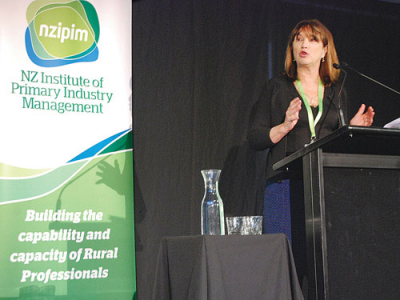 Christine Pitt, of Meat & Livestock Australia, speaks at the New Zealand Institute or Primary Industry Management conference at Lincoln.
Alternative proteins, meat-based snacks, insects, new types of packaging, eating on-the-go, 3D printing of food: change is coming fast and rural professionals need to get with it, says Meat & Livestock Australia’s Christine Pitt.
Notably in the Asian middle class, consumers are becoming much choosier and demanding higher environmental, social, health and wellbeing credentials from their food sources, Pitt says. They are looking for an experience, not just sustenance, from what they eat.
Pitt is MLA’s general manager value chain innovation, responsible for $45 million/year of R&D and commercialisation in the Australian red meat industry.
Speaking to the recent New Zealand Institute of Primary Industry Management conference at Lincoln, she warned of coming disruption.
“If you’re not completely on top of what’s happening with these new technologies then I suggest you’re probably not going to be able to deliver a good service to your clients.”
It is not just single technologies starting to emerge but their convergence -- how they will all work together -- that will fundamentally change the way farming is done.
Many new businesses, start-ups and entrepreneurs are entering the agribusiness sector, Pitt says.
“If you’re not already thinking about what these people are doing they’re going to displace you fairly quickly.”
However, she believes disruption is not all bad and represents some great opportunities.
Snacking, eating on-the-go and particularly protein snacks are a huge growth sector, with consumers starting to turn away from some traditional grain-based snacks they see as not healthy or too sweet.
For example, Epic, a Texas company recently bought by the food giant General Mills, makes a range of meat-based snack bars. These retail for the equivalent of about $100/kg of red meat -- some even for $180/kg.
“Why would you put another kilo of red meat in a box and call it ‘trim’ and sell it, or send it to the US and sell it for hamburger meat, when you can do this with it? It doesn’t make sense.”
These markets did not need to be invented, she added.
“Consumers around the world are shouting at us. This is the kind of thing they are looking for.
“What we know now is that consumers want to get their foods quite differently, they want to eat different foods, they want them produced in different ways,” Pitt explained.
“Asia is also driving a lot of this investment in new ventures. So if you thought Asia was a place where we go to tell them how to do things, think again. They’re already getting ahead of us.”
Pitt says smart people, smart companies and smart countries are starting to work out what they would do with all these trends, and that is the challenge for everyone.
Some of the big red meat companies are themselves starting to invest in alternative proteins.
“You used to be able to see out your career sticking to your knitting or defending your core business but it’s no longer going to be the case.”
Pitt said, at the risk of offending some of her audience, the days of thinking about R&D then R&D extension as separate steps, are dead. Rural professionals can no longer wait for research to be done then think about how to get “those dumb farmers” to adopt it.
“That’s not the way we are going to change the industry, and if you are a rural professional who thinks that’s your job, it’s time to panic because that doesn’t work. We now must have a much more dynamic systems-based approach to how we work together with producers, researchers, scientists and technology companies and how we work in terms of bringing all that together so it’s a natural dynamic thing that’s happening all the time.”
Who's NZIPIM?
The New Zealand Institute of Primary Industry Management (NZIPIM) is the peak industry body for the rural profession, with at least 1000 members from a range of occupations including farm management advisors, rural bankers, farm accountants, fertiliser consultants, rural valuers, representatives from industry good organisations, CRIs, universities, and agribusiness service providers.
Newly published research shows overseas consumers have a strong interest in improving their wellbeing through eating red meat, highlighting opportunities to achieve a premium for products with proven health benefits.
Crown research institute AgResearch has partnered with Meat & Livestock Australia (MLA) to survey attitudes among red meat eaters in Australia and the United States towards physical and mental wellness related to consumption of meat.
Cattle prices in Australia have ended their three-year golden run, says Meat & Livestock Australia (MLA).
The Australian cattle herd is expected to increase in 2017 – its first increase in three years.
A global approach to positioning beef and lamb as premium consumer products is a step closer, with Australian research attracting new international collaboration.



Healthy snacking company Rockit has announced Wang Yibo, one of China's most influential celebrities, as its new brand ambassador.
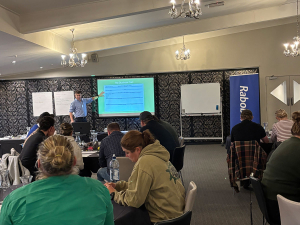
Rabobank has celebrated the tenth anniversary of its AgPathways Programme, with 23 farmers from Otago and Southland gathering for two-and-a-half days to learn new business management and planning skills.
Adopting strategies to reduce worm burden on farm goes hand-in--hand with best practice farm management practices to optimise stock production and performance, veterinarian Andrew Roe says.
Last night saw the winners of the 2026 Beef + Lamb New Zealand (B+LNZ) Awards named at a gala dinner at Te Pae Christchurch Convention Centre.
A 12-month pathway programme has helped kickstart a career in dairy for an 18-year-old student-turned-farmer.
Zespri says its global fruit sales revenue has reached a record NZ$5.9 billion from sales of 248.1 million trays.