Southland Farmer Faces $120k Lamb Loss After Wet Spring
Southland's wet winter and spring will potentially cost Wyndham sheep and beef farmer Ben Dooley between $100,000 and $120,000 in lamb losses.
 increase font size
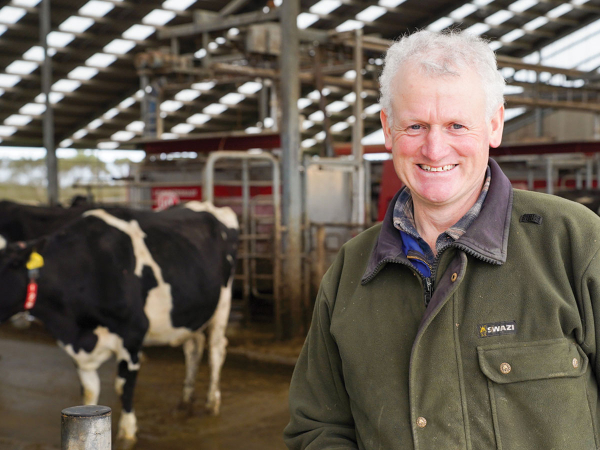 Bruce Dinnington’s farm combines a freestall wintering barn with modernised robotics and a traditional grazing system.
In Dacre, near Invercargill in New Zealand’s South Island, Bruce Dinnington is running a dairy operation unlike any other.
By combining a freestall wintering barn with modernised robotics and a traditional grazing system, Bruce has created a unique hybrid farm that prioritises pasture health and cow welfare.
Running a herd of about 350 cows, the farm utilises six Lely Astronaut A4 robots, four Lely Discovery Collector manure robots, a Lely Calm automated calf feeder and a Lely Juno feed pusher.
The journey to automation began with raising calves. After installing an automatic calf feeder, Bruce noticed huge benefits on how the calves behaved, walking in and out to feed at their own pace. As their 50-bail rotary shed neared the end of its life after 18 years of use, Bruce knew he wanted that same relaxed atmosphere for his cows.
“It’s how quiet and contented those cows were... nobody’s herding them in, nobody’s pushing them out,” Bruce recalls after visiting his first robotic dairy farm. Seeing big, well-fed cows naturally managing their own schedules convinced him to take the plunge.
While the farm does not explicitly operate under a certified organic banner, its entire design is rooted in protecting the natural state of the pastures and promoting holistic animal welfare. The 360-bed freestall barn keeps the cows comfortable and the soils safe from damage during wet winter months.
In the summer, the cows graze naturally outdoors, while autumn brings a hybrid approach where they graze during the day and return to the barn at night for supplements. This flexible, four-way grazing system (A, B, C, D blocks) ensures the cows always have access to fresh, natural pasture while flowing back to the robots at their leisure.
The switch to robotics brought unprecedented insights into herd health. Every milking acts as a full herd test, providing Bruce with health and milk quality control readings for each individual quarter. Combined with milk temperature and somatic cell count monitoring, Bruce can detect mastitis infections much earlier than in a conventional system.
Furthermore, the robots feature built-in scales. If a cow loses more than 7% of her body weight in three days, Bruce receives an immediate alert on his phone, allowing him to catch lameness or other hidden illnesses rapidly before they escalate. “You are no longer just looking at an udder in a rotary; you are observing the health of the entire cow as she walks naturally in and out of the shed,” Bruce said.
The financial and operational benefits have been immense. By downsizing the farm to a family unit and eliminating the need for outside staff, the Dinningtons save approximately $150,000 annually on labour and housing costs. Production has soared from 560 to 750 milk solids per cow.
Thanks to the highly customised feeding and stress-free environment, the herd has transitioned to an 18-month calving interval. This extends the cows’ peak lactation periods and adds three to four years to their lifespan, keeping the “money cows” in the herd much longer. Ultimately, the entire robotic investment saw an estimated five-year payback period.
For conventional farmers hesitant about the technology, Bruce offers simple advice: “If you keep doing what you’ve always done, you always get what you’ve always got”. He encourages farmers to take a leap of faith, visit a robotic farm, and witness the benefits firsthand.
Southland's wet winter and spring will potentially cost Wyndham sheep and beef farmer Ben Dooley between $100,000 and $120,000 in lamb losses.
Returning to the family dairy farm after playing 20 years of professional rugby around the world is no easy task.
Managing feed by sticking to a firm plan has helped the Southern Dairy Hub (SDH) demonstration farm survive an extremely wet winter, says the farm's acting general manager Greg Delaney.
Farmers across parts of Southland and South Otago are continuing to deal with difficult conditions after a prolonged run of wet weather, with pressure building around feed supply, stock management, pasture damage, farm infrastructure and everyday workloads.
A long way from when AI meant plunging a plastic-covered arm armpit deep up a cow’s rear, John Deere has shown off its new artificial intelligence (AI) assistant, aptly called JD, which aims to simplify data processing on farms.

Farmlands has reported higher operating earnings and a profit before income tax of $4.5 million, up 118.9%, for the year ended 30 June 2026.
AgriZeroNZ has invested a further NZ$17.7 million in methane vaccine developer ArkeaBio and NZ$5.1 million in BioLumic, a New Zealand-founded company that uses ultraviolet light to develop low-emissions pasture..
Good news for Fonterra farmers. The co-op has raised this season’s farmgate milk price mid-point by 25c to $9.75/kgMS.
OPINION: Political parties are getting plenty of advice and recommendations from sector groups as the election approaches.
In farming there are external factors that can influence behaviour of a whole herd, such as a bad weather event, triggering false positive heat detections or health attentions.
For Canterbury dairy farmer Cameron Henderson, supporting Meet the Need comes down to a simple question: how can the success of New Zealand farming benefit more than just those within the industry?