As we move further into spring, decisions are being made about working land for cropping, as daytime and ground temperatures increase.
In what is appearing to be a wet spring, there is an increasing need for sunshine and wind to “dry” waterlogged areas, and thoughts will be shifting to what will be the best actions for establishing a good crop.
As with any farm operation there are likely to be several options, but the overriding rule is that increasing working depth also means increasing costs. Indeed, research suggests that 1ha ploughed at 20cm (8”) deep, means moving 2500 - 3500 tonnes of soil, resulting in increased costs around time, fuel, plough metal and general wear and tear.
Farmers and contractors need to understand if a paddock or wider areas of the farm, suffer from soil compaction, they need to understand where the problem lies.
If the upper soil profile is well structured but water infiltration to the lower profile is hindered by a compacted layer, then ponding will occur and/or root growth restricted. Subsoiling may alleviate the problem, but firstly a spade or penetrometer must be used to identify if there is, in fact, a compaction layer and, if so, at what depth.
Often, the compacted layer may be quite shallow – often in the top 100mm – especially if there is pugging caused by stock in wet conditions. If so, soil loosening deeper than 150mm will be a waste of diesel and steel and indeed may cause more harm than good.
If the upper soil profile is well structured and there is no compaction layer, but the subsoil is not porous (e.g. clay), then subsoiling (soil loosening) will only ‘increase the size of the sponge’. This might result in a short-term improvement in the amount of water the soil will absorb but it will still become waterlogged with high rainfall events.
In this case, excess soil moisture can be moved away with macro-drainage, either sub-surface (mole drains, tile/pipe) or surface drainage. From a micro-drainage perspective, soil structure is the key, looking for a nice crumb structure throughout the profile.
Macro-drainage combines two elements: letting water infiltrate into the lower soil profile (soil loosening), and moving water away from the lower soil profile (drainage). Of course, the efficacy of subsoil macro-drainage relies on micro-drainage, via good soil structure to work. Both areas must go hand-in-hand.
Industry experts suggest that far too many farmers and contractors continue to treat soil as dirt and often fail to understand that their actions might be driven by the limitations of the drill they are using. Indeed, solving a sub-soil problem doesn’t always mean moving all the soil above it. That might be addressed by an option such as shallow sub-soiling followed by no-till drilling.
Given a wet spring, it might be worth going back to basics: having determined there is excess soil moisture, often indicated by ponding, what is the best remedial action – subsoiling or drainage?
Rural News recognises the contribution of Bill Ritchie, product specialist Carrfields Machinery, in putting together this article.
Soil Loosening
Soil loosening is perhaps a better term than subsoiling because the target compacted layer may be in the upper soil layers, not the subsoil.
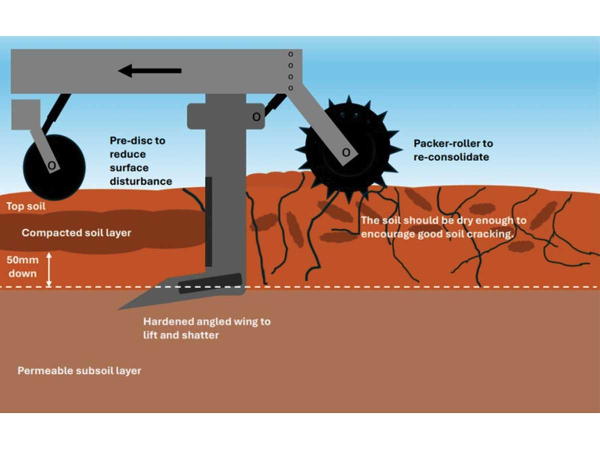
Soil loosening does not necessitate full tillage and can be achieved with relatively minor surface-soil disturbance. Soil loosening is appropriate when a compacted soil layer has been identified above a porous sub-layer (e.g. gravel, sand or well-structured soil). The objective should be to allow water to percolate freely to the lower soil profile. Drainage systems (mole, pipe or surface) are intended to remove excess water from the soil profile where there is not adequate capacity to absorb it. They are also dependent on a well-structured upper soil profile.
By contrast, when soil loosening, depth is important, having determined that a compacted layer exists and identified at what depth (using a soil penetrometer or spade), ensuring that the soil looser is accurately adjusted to only run slightly deeper than the compacted layer.
Like most agricultural operations, timing is crucial, with either process needing to be carried out when the upper surface layers are dry enough to create cracks radiating out from the leg of the soil loosener or mole plough. Late spring will normally provide the best conditions for mole ploughing whereas there is more time flexibility with soil loosening.
Best advice suggests that soil looseners shouldn’t be run too deep, as in some heavy soils this may make the problem worse by causing upward compaction if the ground is too wet, so it is worth remembering, soil loosening will only be effective if the subsoil is porous.
While soil consolidation is positive; soil compaction is negative as compacted layers restrict root growth and water infiltration. If a compacted soil layer exists, it will likely be restricting root development as well as water movement through the profile.
Well-structured soils are likely to be well consolidated. Indeed, some processes such as rolling are often required for the re-consolidation of the excessive soil movement and loosening resulting from soil disturbance. The reality is soil can seldom be consolidated back to anything close to its starting point prior to tillage. The process only becomes a negative when it becomes excessive, typically becoming restrictive or impervious to root penetration or water infiltration.