Paris Agreement: What Are the Costs and Returns to NZ?
OPINION: We are only weeks from the election, and my vote is looking for a home.
 increase font size
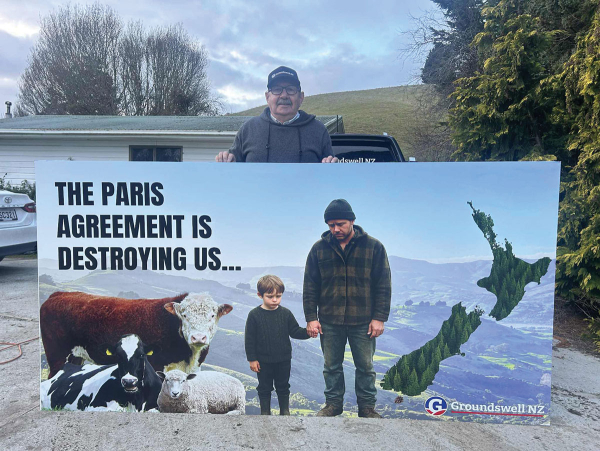 Signs like these are being put up around the country by Groundswell.
OPINION: Defenders of New Zealand remaining bound to the Paris Agreement typically run the same argument. They do not explain the benefits of remaining bound to Paris, because there are none. At least none that are certain and enduring.
The only one they can muster is the possibility of export trading advantage. But given the international perception of New Zealand as clean, green and world leaders in sustainable emissions-efficient food production, that argument is tenuous.
Instead, they prey on our fear. Not of what will happen, but speculation what could happen. This scaremongering led to the widely publicised claim of a loss of $3 per kg on the dairy farmers milk payout if we exited the Paris Agreement. The source of this $3 claim came from a discussion between one of our industry leaders and a dairy company employee. When we requested evidence backing up this claim, communication ceased.
Another key piece of information defenders of Paris avoid outlining is the costs of being bound by the Paris Agreement. No mention of the $400 million the Government is pouring into agriculture emissions research over the current 4-year period. Or the multiple bureaucracies such as the 50/50 government/private sector AgriZero investing $200 million into speculative methane cures and the Pastoral Greenhouse Gas Research Centre’s $90 million in the last 22 years, and what to show for it? Or the up-to-$24 billion bill that Treasury warned we could face to meet Paris climate targets.
There is also no mention of the opportunity cost of our hundreds of millions of taxpayer’s dollars that would be better utilised helping our ailing health system or desperately needed key infrastructure upgrades.
It is not just financial costs but other costs like loss of productive farms and indigenous biodiversity to pines driven by the Paris Agreement’s flawed myopic focus on emissions to the detriment of other values. Oh, but food production is protected under the Paris Agreement, they say, not reconciling the fact we are losing hundreds of thousands of hectares of food producing land because of the Paris Agreement.
By contrast to the one-sided defenders of Paris, Groundswell NZ acknowledges there are risks either way. However, when considering knowns verses unknowns, the answer is clear. The Paris Agreement as currently written is bad for many countries, not just New Zealand. Bad for farmers, bad for our economy, bad for our landscapes and environment.
Our politicians need to show some courage and stand up for our country. It is not a question of giving Paris the middle finger and doing nothing. It is a question of highlighting to other signatories the significant flaws and unsustainable cost implications of being bound to Paris, while at the same time telling the amazing story of New Zealand farmers environmental journey and how we will continue to lead the world in environmentally sustainable food production, regardless of whether we are in Paris or not.
Jamie McFadden is Groundswell environment spokesman
OPINION: We are only weeks from the election, and my vote is looking for a home.

OPINION: A founding principle of Groundswell NZ is that farmers, and people generally, should be provided with full and accurate information about regulations that directly affect them.
Politicians calling for New Zealand to withdraw from the Paris Agreement on climate risk damaging two of our gold-plated free trade deals.
OPINION: Many sheep and beef farmers will be worse off under the new environment legislation than they were under the Resource Management Act (RMA), claims Beef+Lamb New Zealand (B+LNZ) in an email to levy payers.
Prime Minister Christopher Luxon says withdrawing from the Paris Agreement on climate change would be “a really dumb move”.


South of the central Hawke’s Bay town of Waipukurau is Taniwha Station – a highly successful 550ha bull beef farming operation.
Beef + Lamb NZ funded research has shown that some simple changes to pasture management could help farmers make better use of rainfall and build resilience before dry conditions hit.
OPINION: There could hardly be a more appropriate theme for a conference than the one chosen by the red meat sector - Navigating Volatility.
When Northland leather worker Vernon Suckling started making horse saddles 50 years ago, quad bikes and side-by-side vehicles were unheard of.
Alliance Group has confirmed that eligible farmer-shareholders who supply and continue to back the business will receive up to $20 million later this year, following the strategic investment partnership with Dawn Meats.
With a general election under five weeks away, Rural News is asking major political parties about their policies and positions on key issues facing the primary sector. We will run their responses to each question over the next four weeks. The ACT Party and the Greens didn't respond in time.