
Federated Farmers Welcomes ACT’s New Farming Policies
Federated Farmers has welcomed new rural policies released by ACT, saying they align closely with its own election priorities.
 increase font size
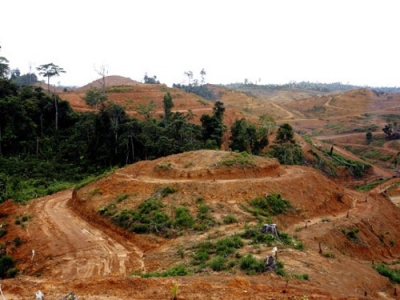 Deforestation in Indonesia. Photo: Greenpeace/Oka Budhi.
Federated Farmers says palm kernel expeller (PKE) is not to be blamed for Indonesian forest fires.
The fires, which have burned for more than three weeks, were a result of clearing rainforests and peatlands for palm plantations. Indonesia is now on track to release more carbon dioxide this year than the entire United Kingdom.
"It's important to remember that PKE is not the reason for these fires or tropical deforestation. It is a by-product of the extraction of palm oil and palm kernel oil which would otherwise be treated as waste," says Federated Farmers Dairy chair Andrew Hoggard.
"Dairy farmers are taking this waste product and making use of it as a supplementary food source, used mainly as an alternative to pasture during adverse weather such as droughts, to maintain the welfare of herds and the productivity of New Zealand's vitally important dairy industry."
The Feds say they echo the concerns of Greenpeace and others regarding the devastation and environmental impact of forest fires.
However, Greenpeace has in the past condemned PKE for contributing to deforestation and its high carbon cost.
Greenpeace executive director Dr Russel Norman is now urging Fonterra to provide evidence that its use of palm products is not contributing to the fires.
Hoggard replied "This is typical tall poppy stuff. Fonterra and its dairy farmers source their PKE from a single suppler that operates on a sustainable basis."
"This provider – Wilmar – has a 'no burning, no deforestation' policy and its plantation operations are audited by The Forest Trust, an independent, non-government organisation. To lay any of the blame for these fires with Fonterra is utterly unfair."
Federated Farmers has welcomed new rural policies released by ACT, saying they align closely with its own election priorities.

Federated Farmers is backing Feilding High School’s call to keep Agriculture and Horticultural Science as a standalone subject in Year 11.
As part of its Election 2026 coverage, Rural News asked political parties how they would help pull the arable sector out of the doldrums. Here's what they said:
National’s pledge to introduce 19 new national standards shows the party is serious about getting Wellington out of farming, Federated Farmers says.
OPINION: Rivers never sit still. They start as snowmelt and rain in the high country, pick up a creek here and a stream there, and carry all of it down to where it's needed.


Federated Farmers has welcomed new rural policies released by ACT, saying they align closely with its own election priorities.

Rural Contractors NZ says proposed changes to land transport rules for agricultural vehicles are a welcome response by the Government to out of date regulations which have seen members hit with huge fines.
Alliance is calling for final applications for its 2027 Graduate Programme, with applications closing on Sunday 25 October.
Decades piloting planes has ensured vet and farmer David Hayes is focused on safety. So, after a serious accident while welding on farm, he is sharing his experience so others can learn from it.
Canterbury milk processor, Synlait Milk has confirmed Leon Fung as its chief executive officer.
OPINION: Making it easier to collect rainwater and use it to grow crops and livestock is a no brainer.