
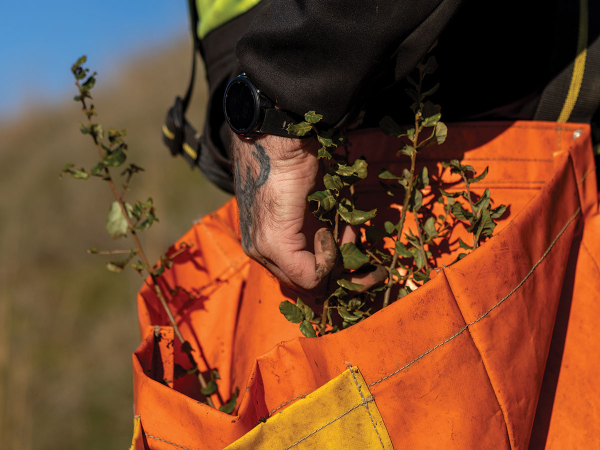

The French-owned Marlborough wine company is working with three local tech startups to boost biodiversity on the 110 hectare property, where 45ha of grapes are dwarfed by long valleys of tree plantings, naturally regenerating native groves, and roads and waterways lined with flourishing flax and grasses.
Jon Church, who has been leading the company’s biodiversity programme since July 2022, says Clos Henri is working to integrate the French philosophy of terroir with the Māori concept of te taiao, connecting land, water and air in the natural world. “We are trying to get the best terroir for growing the grapes, with the best te taiao for the property.”
In order to do that in the most effective way, Jon has partnered with Marlborough-based companies Nature Point (see page 24) and MapHQ, along with Nelson’s Mosaic Aotearoa, with each offering the project a different lens.
Mosaic Aotearoa has used digital mapping to develop biodiversity plans for the property, considering the likes of vineyard viability, erosion risk, water availability and aesthetics to determine the best plantings for each area. The hillside behind Clos Henri’s iconic chapel tasting room, for example, is now planted in a band of natives, followed by a strip of deciduous trees, kahikatea (a native nod to the pine trees that once filled the backdrop), and sequoia at the top.
A valley beside the winery has been planted in kānuka and mānuka, with a colour palette shifting from burgundy, pink and red at one end, to whites and yellows at the other, symbolising the company’s terroir-driven wine varieties. Hillsides of remnant and naturally regenerating natives are protected with pest trapping and weed control, and a knoll in the middle of a new vineyard block has been earmarked for a native grove.
There are also walnut trees near the Sainte Solange Chapel, emulating the Sancerre vineyards of the Bourgeois family that own Clos Henri. In accordance with the family’s farming philosophy, they’re looking for as many “biodiversity triangles” as possible, offering ecological corridors for native birds, says Jon, referring to the Wairau Nature Network, which is aiming for 15% native vegetation cover in the Wairau lowlands by 2045.
Geospatial experts MapHQ have also mapped the property, offering nuanced layers of information, including soil types, water runoffs, and future land use. “We were able to input soil structures and in one incredible view we were able to see the fault line that runs through the property and see the flow path of the ancient rivers,” Jon says in a testimonial for the company. The most recent startup association is with Nature Point, using soil data and satellite imagery to determine soil carbon content, including the parcel involved in Clos Henri’s nascent soil health project.
Jon says the biodiversity project began in 2015, and has amped up over the past three years, including an annual planting day each winter, with dozens of locals putting in around 1,200 trees, before a barbeque at the chapel. They’re also planting for the sheep that graze the vineyard after harvest, with nearly 700 shade trees. A 10ha block of forestry pine, halfway through its lifecycle, is likely to be replanted in natives after its harvest, adjoining a valley of mature kānuka and mānuka, and a hillside of small but flourishing self-seeded trees.
Two months ago, a kārearea from the Marlborough Falcon Trust was released in this valley, joining the hawks that help keep pest birds under control as fruit ripens. As we look over the mosaic of vines, natives, pastures and exotic plantings, Jon points out one of many feeding stations attached to the fence, designed to invite raptors to the vineyard around veraison, “so we don’t have to rely so much on netting”.
For the Clos Henri team, and the Bourgeois family supporting them, it’s only natural to have vineyards surrounded by a complex ecosystem, Jon says. “We are in this for the long haul and ultimately the good of the land.”

