Vintage 2024: On the High Wire
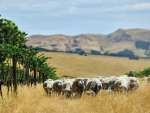
Greystone's High Wire project is set to expand across 25% of the North Canterbury vineyard, allowing sheep to graze those blocks year round.
 increase font size
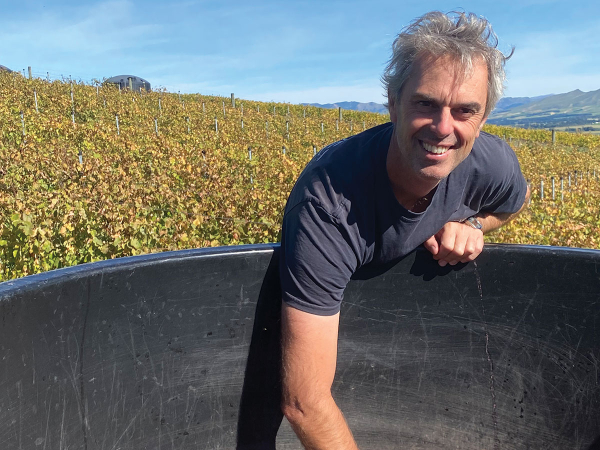 Dom Maxwell
There's a particular type of winemaker who likes to do things quietly, letting quality do the talking, waiting for the right people to find their wines. Dom Maxwell is one of them.
Watchful, thoughtful, intuitive and seemingly all-round chill, after two decades as Head Winemaker at Greystone Wines in North Canterbury, and latterly General Manager, he has recently stepped away to pursue his own label full time.
Forager has existed since 2012, quietly accumulating a following sommeliers and wine lovers, and Dom says the timing felt right for this carefully tended side project to become his main focus.
The Greystone chapter was formative and genuinely rewarding.
"I loved and relished my time at Greystone," Dom says. "Especially the excitement and aspiration of the 'building' phase. We built good working relationships and strong bonds."
The GM role that came later was enjoyable, while intense, he says.
"I felt the time had come for a change in generation, to let new ideas and different perspectives flourish."
Focusing on Forager has allowed him to carve out more time with family, have flexibility around his wife's work, and enjoy the mental clarity and time efficiencies that come with being one's own boss.
The heart of Forager is Isolation Hill vineyard, whose name does not flatter to deceive.
Situated at Waiau, inland North Canterbury, near the Amuri Limeworks, the vineyard sits atop a limestone seam at roughly 210 metres of elevation, and around 40 kilometres from the nearest from the nearest other producing vineyards - Bell Hill and Pyramid Valley.
The site was spotted by Pyramid Valley co-founder, the late Mike Weersing, who approached farmers Andy and Jill Black about planting it.
Pinot Noir went in around 2000, with the Blacks supplying fruit to Pyramid Valley and a few other wineries.
That arrangement, while functional, left the fruit somewhat anonymous, disappearing into larger blends. When Dom came across the vineyard - tipped off at a wine dinner - the fit was immediate.
Andy Black is, by Dom's description, one of the most infectiously positive people you'll meet; an old-school farmer with a genuine love of wine, who lights up around winery talk.
Dom wanted only a small amount of fruit and the Blacks wanted a closer relationship with whomever was making wine from their hillside, plus a few barrels of their own wine.
Nearly a decade in, the deal still runs on a handshake.
The vineyard is high-density, predominantly Abel and 667 clones.
The Blacks manage the viticultural work throughout the year, while Dom heads to the site closer to harvest to assess fruit and canopy.
The elevated site ensures cool nights, which Dom credits for preserving intensity, freshness and vitality in the fruit, and despite its inland location, harvests are typically not particularly different from the wider North Canterbury norm.
What drew Dom to the site is the sheer chalkiness of the soil. He believes you can taste it directly in the wines.
"There's a mineral quality that drives length in quite a remarkable way," he says.
Limestone's capacity to draw up moisture also brings its own challenges - vigour can be surprisingly high for a hillside site - but Dom says the character it imparts in the fruit justifies any logistical complications of operating so far from neighbouring vineyards and wineries.
Those complications are real, not least the need to own all your own gear when there are no neighbours to borrow stuff from, or with whom to share knowledge.
Dom comments that there are likely many promising sites along the limestone seams of inland Canterbury, whose potential will likely go unexplored because the numbers don't stack up, "maybe until the next planting boom, whenever that may be".
Forager's Pinot Noir has always been vineyard fermented, making it one of the earliest adopters of what has become a more discusses, if still rare, practice in New Zealand.
"The original thinking came partly from research emerging from Lincoln University and from Michael Brajkovich's work on native yeasts," Dom says.
His nagging question with pied de cuvée - that even if you inoculated with vineyard-captured yeasts, wouldn't ambient winery yeasts simply take over once the ferment got going in the winery - meant the logical extension was to leave the full ferment in the vineyard.
Dom was discussing this idea at Greystone too, and he and Greystone's then-viticulturist, Nick Gill, ran their first concurrent vineyard ferments together in 2012, one for Forager and one as a Greystone experiment.
Greystone's first commercial vineyard ferment release came in 2016; for Forage, it has been the only method from the start.
The process is exactly what it sounds like - the fruit is crushed at the vineyard and the open fermenter sits out on the hillside for roughly a month.
Whole bunch inclusion varies between zero and 40%, depending on the season, skewing more toward the latter.
Andy Black wanders over most days to wet the cap, and Dom gets there once a week.
When fermentation is done, the fermenter goes onto a trailer and makes the journey back to Greystone winery for pressing.
What Dom didn't anticipate fully was how much that process would teach him about extraction.
The revelation wasn't just about yeast populations - it also was about temperature.
Vineyard ferments run cooler and more erratically than their winery counterparts, spiking and dipping in response to ambient conditions rather than following a smooth bell curve.
The lower fermentation temperatures and different extraction dynamics produce "tannins that are really beautiful, and integrated very early on in the wine's life".
This discovery has progressively reshaped how he now works: no pre-ferment SO2, minimal cap work, almost no plunging beyond keeping the cap moist.
Dom says the vineyard ferment opened the door to "a fundamentally different way for me thinking about winemaking, and the wines".
Contraty to his early concerns about whether such easy finesse could sustain ageing, he says early vintages have demonstrated that structural gentleness and longevity are not mutually exclusive.
He also observes that temperature dynamics of fermenting outdoors are categorically different from anything achievable in a winery.
Forager's production currently sits around 300 cases of Pinot Noir, which Dom expects will grow to around 500 cases.
Little Forager - a "village-style, savoury wine designeed for glass pour price points" - is a similar volume and Dom will soon release Forager's first Chardonnay.
The vines were planted six years ago on the same hillside at Isolation Hill, with three barrels made last year, and around three tonnes anticipated this vintage.
Dom would love to have planted Riesling too, but acknowledges the commercial reality of trying to sell it at the price that site demands; for now, he plans to add 200 cases of Riesling sourced elsewhere.
The ambition is to keep Forager small and built around interesting sites, whatever the variety.
Export markets in Taiwan, Singapore and Shanghai have responded well, and a domestic distributor handles restaurants and retailers in New Zealand.
Dom is happy to let others manage it - he's got a hillside to check on, and a ferment to leave largely to its own devices.
Greystone's High Wire project is set to expand across 25% of the North Canterbury vineyard, allowing sheep to graze those blocks year round.
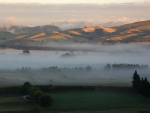
"Conditions are incredible," and "the quality is going to be exceptional", says Mike Saunders from North Canterbury in mid-March, as harvest kicked off for many.
Greystone's 2021 Organic Chardonnay won best organic wine in the country at the 2023 Aotearoa Organic Wine Awards, taking Riedel Wine of the Show as well as Champion Chardonnay.
In North Canterbury, Greystone Viticulturist Mike Saunders is very happy about harvest prospects, with Pinot Noir his pick for the season, due to good flavour development at lower brix.
A dry lead up to spring slowed early canopy growth in North Canterbury vineyards, while cool and wet weather impacted flowering, says Greystone Viticulturist Mike Saunders, who is “cautiously optimistic” in the lead up to vintage.