Why Now Is the Time to Plan Farm Succession, Findex Says
OPINION: Succession and long-term planning are perennial topics because it is perpetually sidelined on busy farms.
 increase font size

Giant buttercup, a damaging European dairy pasture weed that is avoided by cattle due to its acrid taste, is costing New Zealand hundreds of millions of dollars in lost revenue as dairy farmers battle to control it.
The attractive yellow-flowered weed is developing resistance to modern herbicides, in part due to farm management practice, according to AgResearch scientists.
They are warning that since nearly all of New Zealand is climatically ideal for this buttercup, it is an internal bio-security risk to the dairy industry and management plans may be needed to stop it from spreading.
The plant, giant buttercup (Ranunculus acris L. subsp. acris), has been profiled by the Undermining Weeds Project funded by the Ministry of Science and Innovation and has been found in six of the 17 dairying regions in New Zealand.
New AgResearch studies show giant buttercup is one of only a few pasture weeds worldwide to have evolved resistance to herbicides, and a recently developed bio-climatic niche model for this weed indicates that all 17 dairying regions are climatically highly suitable and thus vulnerable to invasion. In addition, the model reveals that irrigation substantially increases the eco-climate suitability of the summer-dry eastern parts of the North and South Islands.
In 2010 a farm systems modelling study funded by DairyNZ under an On Farm Innovation Fund grant to the Giant Buttercup Management Group in Takaka showed that an average 12 per cent peak seasonal ground cover of giant buttercup results in a decrease in the profitability of a typical dairy farm of $1,040 per hectare. Group Project Manager, AgResearch's Dr Graeme Bourdôt says that is a 36% reduction in bottom line profit, and for a farm consisting of 100 1.0 ha paddocks, this would be a probable $100,000 loss in profit per year.
Earlier research showed that in 2001-02 milking season, giant buttercup cost New Zealand dairy farmers $156 million in lost revenue through the reduction in utilisable pasture. Further modelling showed that if the weed were to spread to all 17 dairying regions the total national loss in dairy farmer revenue could increase to between $328 and $748 million per year.
The biggest and immediate challenge for farmers and scientists however is revealed in the most recent research, undertaken by an AgResearch Technician based at Lincoln, Carolyn Lusk. Her Master of Agricultural Science study confirms that the buttercup can evolve resistance to an herbicide that many farmers have been relying on since it was introduced to the market about 16 years ago.
"The recently confirmed herbicide resistance combined with the other studies show how damaging the weed really is and that new research to find a sustainable solution is vital," says Bourdôt.
"Carolyn's experiments compared the herbicide-susceptibilities of giant buttercup populations on Golden Bay dairy farms differing in historical use of the phenoxy and ALS herbicides. Her results provide evidence that resistance to the ALS herbicide flumetsulam is likely to have evolved in populations of the weed due to repeated exposure to the herbicide. The work also gives a possible explanation for the persistence of the weed on dairy farms in Golden Bay and in other regions where farmers have relied on regular applications of this herbicide to control the buttercup."
Lusk's results, in conjunction with earlier research that showed that this weed has also evolved resistance to the phenoxy herbicides MCPA and MCPB, help to support the implementation of herbicide resistance management strategies on dairy farms.
"Farmers have inadvertently been selecting for giant buttercup genes that confer resistance. We are currently developing a proposal for new research that would not only make our current scientific knowledge about this weed readily available to farmers but also compare a range of novel herbicide resistance management tactics," says Bourdôt.
OPINION: Succession and long-term planning are perennial topics because it is perpetually sidelined on busy farms.
Farms across the upper North Island are trialling different pasture mixes as part of a research programme that aims to build greater resilience into farming systems.
Election years are always a concerning time for farmers, according to DairyNZ chair Tracy Brown.
Matt Collier, Probiotic Revolution, says calves will drink a lot of milk once-a-day with their probiotic Calf Xtreme.


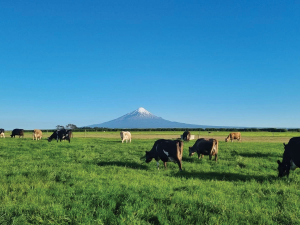
A spate of southerly winds bringing cold temperatures has presented challenges for Taranaki dairy farmers.
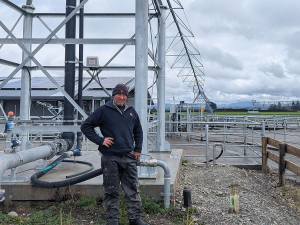
Converting a longstanding cropping farm to dairy was the only way to ensure the land stayed in the family long term, says new dairy farmer Rod May.
As the election heats up, Organics Aotearoa New Zealand (OANZ) has launched its election scorecard designed to help voters wanting to support policies that grow organic and New Zealand's organic sector.
A 'tsunami' of milk from key exporting countries is winding down and this may be good news for New Zealand dairy farmers.
Will the good times last? That's one of the key issues to come out of the latest Federated Farmers confidence survey.
Outgoing Fonterra Co-operative Council chair John Stevenson says that it has been a privilege to represent the co-op's farmer shareholders.