Why Now Is the Time to Plan Farm Succession, Findex Says
OPINION: Succession and long-term planning are perennial topics because it is perpetually sidelined on busy farms.
 increase font size
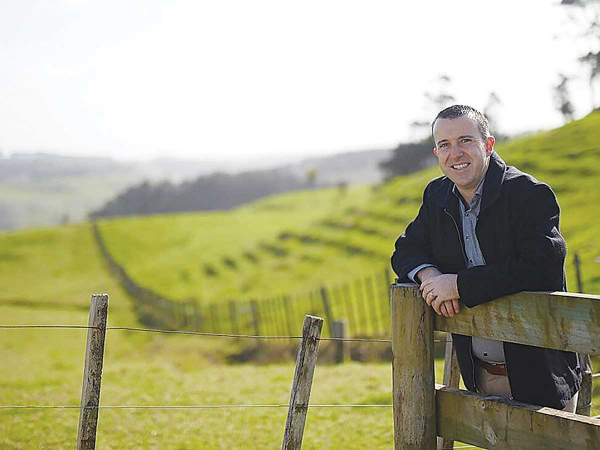 As countries gradually get on top of Covid and the global economy rebounds in the coming years, dairy demand will firm up, says Nathan Penny, Westpac.
Demand for dairy will firm over the next two years as the global economy rebounds from Covid, says Westpac senior agri economist Nathan Penny.
He notes that the trend has already started in China and East Asia where demand has rebounded from its lows earlier in the year.
Westpac has announced a 2021-22 initial opening forecast of $7/kgMS. The forecast is equal to its forecast for 2020-21 and close to the $7.14/kgMS final price achieved in 2019-20.
“Our forecast is higher than the long-run average milk price, although the difference is smaller when the prices are adjusted for inflation,” says Penny.
A key change that Penny expects is that demand and prices for milk fat will begin to normalise.
Currently, milk fat prices are soft as consumers eat less cream and other milk fat products in settings such as restaurants.
“In particular, we expect that the rollout globally of Covid vaccines will gradually allow more people to return to restaurants and other venues that milk fat consumption relies on,” says Penny.
He expects moderate growth in the key exporting countries over the next two years.
“Over recent years, annual growth has averaged in the vicinity of 1%.
“This relatively modest growth is another reason why prices have held up well during the global Covid recession.
“Moreover, we see a low probability that global supply will deviate materially from these trends by enough to offset the impact on prices from rising demand.”
However, there are a few “forecast risks”, including the New Zealand dollar and the possibility that dairy buyers run down stocks after having built them up during Covid to protect against supply disruptions.
“We note that there is a risk that, if the New Zealand economy’s resilience continues to surprise and local interest rates rise, then the NZD/USD could rise beyond what we have assumed.
“In this event, the milk price would be lower.”
There is also uncertainty around global agricultural trade policy.
Penny says Joe Biden’s US presidency may take a more trade and China-friendly stance, thus allowing the US more access to China’s market and thus more competition for New Zealand dairy exports.
“Finally, we assume normal weather conditions going forward. In the case of a NZ drought, global dairy prices are likely rise.”
OPINION: Succession and long-term planning are perennial topics because it is perpetually sidelined on busy farms.
Farms across the upper North Island are trialling different pasture mixes as part of a research programme that aims to build greater resilience into farming systems.
Election years are always a concerning time for farmers, according to DairyNZ chair Tracy Brown.
Matt Collier, Probiotic Revolution, says calves will drink a lot of milk once-a-day with their probiotic Calf Xtreme.


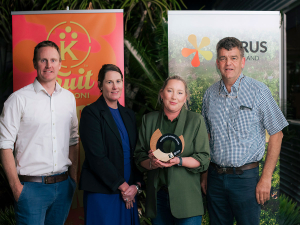
New Zealand's citrus growers were challenged to build their future on the value embedded in their fruit rather than the volume they produce, at Citrus New Zealand's annual gathering in Gisborne on 17 September.

Leading John Deere technicians and apprentices from New Zealand and Australians were recognised at the recent sixth annual JD Technician of the Year Awards, held in Brisbane.
In Dacre, near Invercargill in New Zealand’s South Island, Bruce Dinnington is running a dairy operation unlike any other.
A free online platform aggregating governance vacancies across rural and regional New Zealand has been launched.
Environment Minister Nicola Grigg has announced details of a new rural plastics recycling scheme.
Agricultural drone operators say that a government decision to allow lower-risk drone work without certification won’t lower standards but drive innovation and efficiency.