Why Now Is the Time to Plan Farm Succession, Findex Says
OPINION: Succession and long-term planning are perennial topics because it is perpetually sidelined on busy farms.




 increase font size
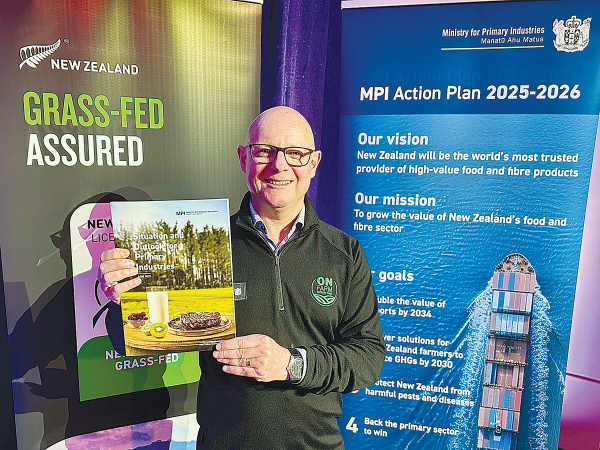 MPI director general Ray Smith says it’s been a blockbuster year for primary exports.
The profitability of dairy farmers is likely to increase in the coming year, accordign to the latest report by the Ministry for Primary Industries (MPI) on the outlook for the primary sector.
It says global dairy prices are likely to increase and farm expenses will stay static and it's predicting that dairy farmers will on average receive a record $10/kgMS farmgate milk price.
This comes on top of what the Director General of MPI, Ray Smith, is describing as a blockbuster year for the primary sector with dairy exports for the year ended June set to reach $27 billion - up 16% on the previous year. This is due, he says, to strengthening demands among traditional dairy importing countries such as China and a slight weakening in global supply.
Overall, primary export returns for the year are close on a record $60 billion and this is due mainly to the performance of the dairy industry. What's more, dairy exports are expected to hit $30 billion by 2029. For dairy, it's been an amazing turnaround, says Smith.
"These global dairy prices have been well above the long-term averages and that's driven a lot of the value," he told Dairy News.
"Full cream related products - cheese and so on - have been fetching incredible prices because in Europe and the US there's beena bit of decline in production. In China, very good prices have been achieved in the food service sector, especially with high value products such as cream and butter doing particularly well. There has even been a pickup of infant formula sales there," he says.
Smith says a combination of global factors have worked in NZ's favour. The exchange rate is one, but a significant factor is the decline of milk production in China and in the US where avian influenza has gone through their cattle herd.
He says in Europe an outbreak of foot and mouth disease in Hungary has affected production and volumes have also been down in Argentina.
Smith says overall on the home front it's been a bumper season and NZ has got through the droughts reasonably well - producing more milk. He says the good spring and summer were key factors and grass growth has been good, with a lot of feed stored.
"To me, what is phenomenal is that there's been a two percent productivity growth in dairy farming alone, which is quite an achievement," he says.
'Amazing Year'
The MPI outlook report paints a picture of an amazing year for the dairy sector.
It notes that on 6 May 2025, Global Dairy Trade (GDT) prices were 18% more than they were a year ago. Figures for some of the individual products, show that the average whole milk price was up 20%, AMF 27% and butter 25%. The report goes on to point out that against their five-year average, butter was up 42% and AMF 31%. SMP prices, while better, are however still below their five-year average.
Back on the farm in NZ, MPI is forecasting a modest 2.2% increase in milk production to the end of June and just a 1% increase for the coming season. Droughts and the early drying off cows in some regions have put something of a handbrake on production.
Some other good news is the prediction that interest rates are likely to continue their decline into the new season.
While there is cause to celebrate this year, Ray Smith warns there are still headwinds to conquer in the future, with the report showing that growth in the coming years will be incremental - around 2%, not the super 16% of 2025.
"I think there is uncertainty in the environment and outlook, and you can't deny that. Among other things we have yet to see the full effect of tariffs play out across the world," he says.
OPINION: Succession and long-term planning are perennial topics because it is perpetually sidelined on busy farms.
Farms across the upper North Island are trialling different pasture mixes as part of a research programme that aims to build greater resilience into farming systems.
Election years are always a concerning time for farmers, according to DairyNZ chair Tracy Brown.
Matt Collier, Probiotic Revolution, says calves will drink a lot of milk once-a-day with their probiotic Calf Xtreme.

Entries are now open across eleven regions for the 2027 New Zealand Dairy Industry Awards (NZDIA).

Safer Farms is urging farmers to make sure everyone working on farm has safe, suitable footwear for the job.
The Government is backing work on a community-led water storage scheme that could irrigate up to 11,000 more hectares of the Poverty Bay flats, Agriculture Minister Todd McClay says.
Agri-tech company Herd-i has become a new all-region sponsor of the New Zealand Dairy Industry Awards (NZDIA), the largest nationwide celebration of excellence in the dairy sector.
Four candidates have been confirmed for two director positions on Fonterra’s board.
Returning to the family dairy farm after playing 20 years of professional rugby around the world is no easy task.

OPINION: It seems Canterbury processor Synlait is still in the doldrums.
OPINION: Get offside with New Zealand First leader Winston Peters at your own peril.