Feilding Agricultural High School isn't alone in offering agricultural or horticultural subjects as part of its curriculum, but the location of one of its farms on the northern edge of the urban fringe makes for some interesting considerations.
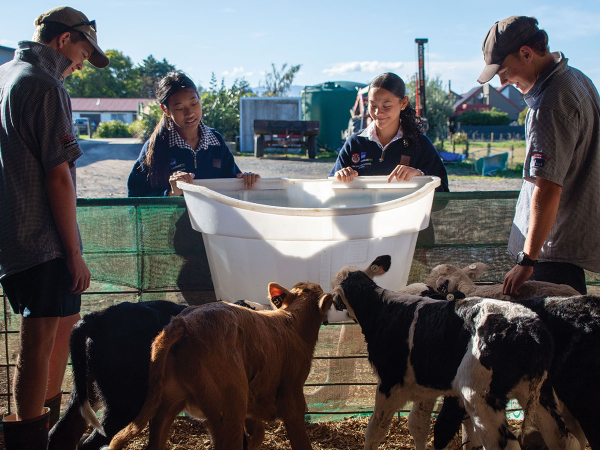
Owning two farms, Ngakanui, adjacent to the main school campus, runs to 16ha and carries 60-65 Friesian cows, milked through a De Laval VMS (voluntary milking system).
Farm Manager Highlights Importance of Operational Standards
Farm Manager Finn MacDonald explains that the location - which is currently seeing a large-scale housing development on its nothern boundary of up to 1000 homes - means the farm must be seen to be doing things correctly.
"We ensure we operate under an industry best-practice regime at all times, meaning we keep things very neat and tidy and animals are in tip-top condition."
An output of 28,000kgMS/annum sees an average production of 450kgMS/cow and 1855kgMS/ha.
Winter feed takes the form of 50 tonnes of bought-in maize silage, complemented by 100 bales of grass baleage.
Manawanui Farm Supports Sheep, Beef, and Forestry Systems
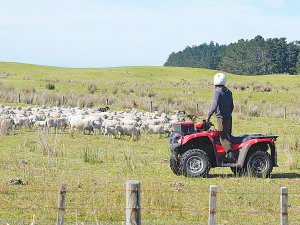
The school's second farm, Manawanui, is located on the hillside to the west of the town, running to 81ha and operated as a beef and sheep unit, with the primary outputs being finished trade lambs and cattle, complemented by some small-scale forestry.
Summer cropping of 15ha chicory and 6ha of rape is used in Jan/Feb to supplement grass, with a return to grass after grazing.
Finn explains, "we typically finish up to 2000 trade lambs, alongside Hereford-cross cattle that head off to the works at around 550kg liveweight".
Agricultural Education Pathway Attracts Hundreds of Students
Interestingly, with a total recall of 1600 students, 600 choose to be involved in the agricultural and horticultural pathway during Year 9 and 10, then carrying on with a combined course through Years 11 to 13.
These courses focus on the place of NZ agriculture, livestock production, soil and plant science, plant propagation, primary production and sustainability.
Alternatively, students can apply to take part in the Primary Industries Programme in Year 11, then attend a one-day farm placement per week in Years 12 and 13. This course focuses on livestock handling, drenching and vaccination, fencing, safe operation of farm vehicles, dagging, crutching and shearing.
An extra-curricular programme allows students to sign up to agrisports, rural games, beekeeping, wool handling courses, crutching, dagging and shearing courses, interhouse shearing and wool handling, and Lamb and Calf Day.
Rural/Urban Mix
Head of Agriculture and Horticulture, Kain Nixon says that students on the agriculture and horticulture courses are typically from a 70:30 rural/urban background, moving through the years in a 50:50 male/female mix.
“By the time they reach Year 12 and 13, this switches to an 80:20 in favour of the girls.”
He goes on to explain that the aim of the courses is to give students a broad overview of an industry that is a key driver of the NZ economy and sow the seeds to agriculture as a subject to follow in higher education.
“We would love to offer an even greater overview, showing that an agricultural qualification is not just about working on farms, but the pathway to a multitude of support industries within the sector. But like many other establishments, unfortunately we don’t have a finite budget.”
With Agriculture evolving rapidly with new smart technologies arriving on an almost daily basis, farm manager MacDonald explains, “I typically have three students acting as my shadow on most days, so its important to expose them to day to day tech such as the VMS robot, our weighing and identification systems using EID tags, while also ensuring they take on basic skills like sheep shearing- which is also very popular, but not forgetting hygiene issues like crutching and dagging, which usually aren’t undertaken with so much enthusiasm.”
www.feildinghigh.school.nz