Damien O’Connor Criticises Budget 2026 as ‘Miserable’ for Rural New Zealand
A miserable budget that didn’t deliver much for anyone.
 increase font size
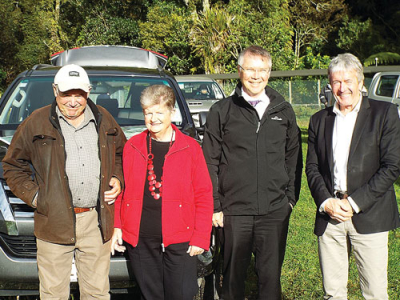 Environment Minister David Parker and Agriculture Minister Damien O’Connor with Cambridge farmers Bill and Sue Garland.
The double-D’S were front and centre at Karapiro, Waikato, recently to promote a voluntary water quality initiative.
David Parker and Damien O’Connor, ministers for the environment and agriculture, respectively, joined industry leaders to endorse the Good Farming Practice-Action Plan for Water Quality 2018.
The plan was developed largely from principles set out in the 2015 Industry-Agreed Management Practices first applied by Environment Canterbury.
The voluntary initiative is led by Federated Farmers, Beef + Lamb NZ, Dairy NZ, Horticulture NZ, Irrigation NZ and people from regional councils and regulatory authorities.
The chief aim is to help make rivers swimmable and to improve the ecology of waterways, so the plan advocates good farming practices -- assessing individual and regional catchments, measuring and showing improvements and telling the public about progress.
At grassroots level this will see workable plans being drawn up to identify physical and topographical constraints, and identify land where cropping should cease because of erosion risks. The plan includes keeping accurate records of inputs and outputs, and managing run-off, sediments and nutrients entering waterways.
Environment Minister David Parker applauded the voluntary nature of the plan and conceded that regulation “might not be the b-all and end-all”. But he said rules and regulations would be part of the solution, as would better education and perhaps “pricing” to influence behaviour.
Parker’s former flatmate Minister Damien O’Connor noted “the need for guidelines in tune with the environment, and for a part of the social licence that allows landowners to operate”.
NZ agriculture and horticulture needs to be the best producer in the world, he said, with their output “food for people who care, produced by farmers and growers who care”.
The plan now is to spend the next two years enlisting farms and local and regional authorities in a campaign going through to 2030.
A miserable budget that didn’t deliver much for anyone.

National's decision to ‘dribble’ information about the NZ/India to Labour contributed to the delay in it deciding to supported the FTA.
When it comes to international trade, politicians from all sides of the aisle are united, says Labour's trade spokesman Damien O'Connor.
OPINION: In a victory for common sense over virtue signalling, David Parker's National Policy Statement (NPS) work on freshwater is now dead in the water.
Federated Farmers have reiterated their support for the coalition Government to abolish the present ban on the live export of animals.


Federated Farmers has welcomed new rural policies released by ACT, saying they align closely with its own election priorities.

Rural Contractors NZ says proposed changes to land transport rules for agricultural vehicles are a welcome response by the Government to out of date regulations which have seen members hit with huge fines.
Alliance is calling for final applications for its 2027 Graduate Programme, with applications closing on Sunday 25 October.
Decades piloting planes has ensured vet and farmer David Hayes is focused on safety. So, after a serious accident while welding on farm, he is sharing his experience so others can learn from it.
Canterbury milk processor, Synlait Milk has confirmed Leon Fung as its chief executive officer.
OPINION: Making it easier to collect rainwater and use it to grow crops and livestock is a no brainer.