Fonterra FY26 Results: $9.69 Milk Price, $3.4bn Profit
Fonterra has unveiled its annual results for the 2026 financial year, posting $27 billion in revenue and close to $20 billion returned to New Zealand farmer owners and unit holders.
 increase font size
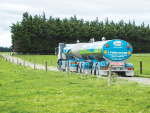
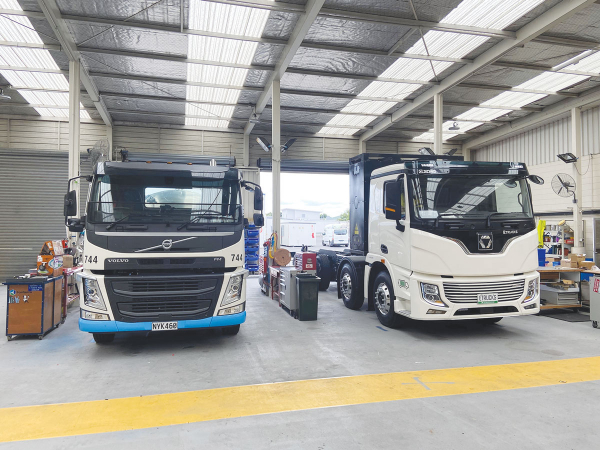 Fonterra's first electric milk tanker (right) being footed out at its Morrinsville garage.
New Zealand's first electric milk tanker (E-tanker) will hit roads around Fonterra's Waitoa factory in May.
The E-tanker is part of the Fonterra's Electric Vehicle (EV) strategy that will see a third of the co-op's light vehicle fleet converted to EV's by the end of 2023.
The co-operative is trialling the first E-tanker to understand what the future of electric milk collection and rural heavy transport looks like.
Fonterra chief operating officer Fraser Whineray says the first E-tanker is very much a trial.
"We'll be looking at a number of factors including; how far it can go, how easy it is to charge, milk collection, maintenance, efficiency, cost, and driver comfort and safety.
"This is very much a trial and we're looking forward to learning more about heavy vehicle E-Transport in a rural setting."
The cab and chassis are from XMCG - a Chinese construction machinery group: Fonterra's team will fit the 'tank' part of the tanker to it.
Whineray says improving emissions across the entire supply chain is part of the co-operative's overall commitment to sustainability.
"The global technology investment in sustainable land, air and sea transport is phenomenal," says Whineray.
"Our teams are constantly screening the possibilities to see what could work across our supply chain."
The Waitoa plant has been chosen to host the first E-tanker because close supplying farms are mostly on relatively flat land.
Whineray says this will allow Fonterra to do shorter runs where battery consumption be reduced with less hills.
"Since Waitoa was home to the biggest fleet of electric milk trucks, it is also fitting that in New Zealand it becomes home to the first modern milk collection electric tanker in New Zealand," he says.
The E-tanker can carry 28,000 litres of milk - the same as a regular tanker. However, because the 'truck' part of the tanker is a bit heavier with the battery it will carry around 2,300 litres of milk less.
This is so we can operate within our permitted weight, says Whineray.
Each tanker takes about three hours to charge: however E-tankers will operate on a 'battery swap system' so tankers won't be lying idle while charging.
Fonterra expects its team to swap the battery out in about six minutes.
State Funding
The country's first electric milk tanker project is receiving co-funding from the Government's new-look Low Emission Transport Fund (LETF).
Minister of Energy and Resources Megan Woods says the LETF is all about finding replicable solutions through innovative transport and infrastructure.
"The project included in this round show the potential for electric and low-emissions transport across a wide range of sectors: from all-terrain farm vehicles to heavy freight.
"Some of these are hard to decarbonise, so this is great progress towards reducing out transport emissions." says Woods.
Fonterra has unveiled its annual results for the 2026 financial year, posting $27 billion in revenue and close to $20 billion returned to New Zealand farmer owners and unit holders.
Fonterra Co-operative Group has confirmed the independently assessed candidates standing for election to its board in 2026.
Fonterra has revised its Farmgate Milk Price forecast for the 2026/27 season, lifting the midpoint and narrowing the range on the back of improving global dairy commodity prices.
Outgoing Fonterra Co-operative Council chair John Stevenson says that it has been a privilege to represent the co-op's farmer shareholders.
OPINION: It seems Canterbury processor Synlait is still in the doldrums.


Farmers across parts of Southland and South Otago are continuing to deal with difficult conditions after a prolonged run of wet weather, with pressure building around feed supply, stock management, pasture damage, farm infrastructure and everyday workloads.
Federated Farmers says it welcomes Labour's commitment to reviewing the Sharemilking Agreements Act, calling on other major parties to do the same.
For Canterbury dairy farmers Sian Meijer and Rick Wobben, wearable technology has become one of their most valuable on-farm tools - helping manage 1850 cows across an expansive, high-performing dairy operation while improving efficiency, mating outcomes and day-to-day decision making.
Fonterra has unveiled its annual results for the 2026 financial year, posting $27 billion in revenue and close to $20 billion returned to New Zealand farmer owners and unit holders.
The first major update to the Dairy Cattle Code of Welfare in more than a decade has been released, marking what DairyNZ describes as an important step in ensuring animal welfare standards continue to evolve alongside scientific evidence and on-farm realities.
Ravensdown shareholders have elected Jane Montgomery and Kate Acland to the Ravensdown Board for three-year terms, following a closely contested director election.