Federated Farmers Praises Labour's Emissions Tax Backdown
For the first time in a quarter of a century, Federated Farmers has something positive to say about the Labour Party’s climate change policy leading into a general election.
 increase font size
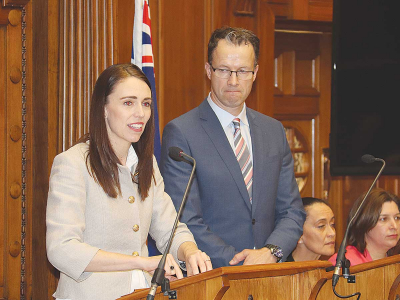 Prime Minister Jacinda Ardern and DairyNZ chief executive Tim Mackle at last week’s announcement in Wellington.
The emissions train is leaving the station and farmers need to be aboard, says DairyNZ chief executive Tim Mackle.
He was responding to last week’s news that the farming sector and the Government have signed a plan to reduce primary sector emissions.
The plan will see the parties together developing practical, cost-effective ways to measure and price emissions at farm level by 2025.
To advance this the Government has introduced the Climate Change Response (Emissions Trading Reform) Amendment Bill due for a first reading next month and then referral to a select committee.
The aim is to reduce farm emissions by 2025, but there is a proviso in the Bill which stipulates that if the independent Climate Change Commission doesn’t think sufficient progress is being made at farm level the Government will intervene.
A five year action plan will include providing better tools for estimating and benchmarking emissions on farms; integrated farm plans that include a climate module; investment in research, development and commercialisation; increased farm advisory capacity; and capability and incentives for early adopters.
The plan is based on a document He Waka Eke Noa – Our Future in Our Hands developed by the primary sector and it negates a proposal on this subject in July of this year.
Prime Minister Jacinda Ardern says the agreement is a world first which moves New Zealand closer to its goal to become the world’s most sustainable food producer.
“We need a plan that supports our environment but also one that support our primary sector. A plan that is practical, innovative and achievable.”
Ardern says it’s great to see primary sector leaders sharing the same aspirations as the Government.
Mackle says the sector is grateful that the Government has listened to the industry and devised a pragmatic solution. In this win win situation the Government wants to get moving forward at the same time as we want the right approach -- a time to work through the issues, he says.
“There are still a lot of details that we have to work through. This gives us time and I think farmers will appreciate that. It’s also certainty for farmers and it gives time to work through these things carefully.
“We must be able to measure things at a farm level and put farm plans in place so that farmers have clarity on what they need to do to manage emissions.”
Mackle says they must continue with R&D of mitigation options.
But he says DairyNZ is not entirely happy with the Government intervention arrangement and doesn’t think it is necessary.
For the first time in a quarter of a century, Federated Farmers has something positive to say about the Labour Party’s climate change policy leading into a general election.
DairyNZ deputy chair Cameron Henderson has been re-appointed unopposed for another term.
OPINION: The stats speak for themselves.
Farms across the upper North Island are trialling different pasture mixes as part of a research programme that aims to build greater resilience into farming systems.
Election years are always a concerning time for farmers, according to DairyNZ chair Tracy Brown.


Farmgate lamb prices are down by 8%, beef cattle by 4.5% and farm expenditure up by 4.2%.
Kiwifruit growers are watchful but remain optimistic as concerns around the potential effects of the El Niño weather pattern this season.
Almond hulls sourced from Australian orchards may have the potential to help New Zealand cows reduce emissions, boost milk yield and lower input costs.
Striking a balance between meeting the needs of industry to speed up approval time for products but on the other hand ensuring that risks are properly assessed.
Surprised, humbled and quite thrilled. That’s the reaction of James Allen, one of the founding partners and now chief executive of AgFirst, on being made a life member of the Institute of Rural Professionals.