
George Dodson on Efficiency and Low-Cost Dairy Farming
Efficiency is the big one because it tracks back into what is done on farm.




 increase font size
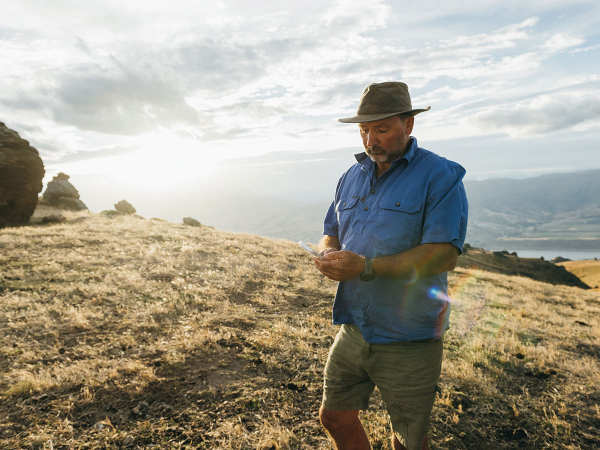 Farmer Bevan McKnight knows exactly where to look for his Angus cattle on the 13000ha station he leases.
Central Otago farmer Bevan McKnight no longer worries about leaving a few Angus cattle behind while mustering on the 13,000ha station he leases.
With the Halter collars on his 200 Angus cattle now linked to satellite technology, he knows exactly where to look for them at Northburn Station in the Dunstan Mountains.
"We know exactly where to walk to and where to find them," he told Rural News.
"Previously, we always left a few behind and had to go back to look for them."
McKnight was one of a handful of farmers who trialled the direct-to-satellite technology for beef cattle smart collars, a world-first solution driven by Starlink and One NZ.
He says the collars were linked to the satellite on February 26. The results are a game changer, he says.
McKnight says direct-to-satellite will also unlock unconstrained grazing.
"Virtually fencing our extensive station using Halter will be a game-changer for land utilisation.
"For the first time, we'll be able to graze large blocks of land that have never been touched by our cattle, because we had no way of managing them there."
McKnight says to have Halter collars on cattle before this satellite solution would have required 25 towers.
"So, this new practical option makes Halter a no-brainer for us."
The station also has fragile areas that are environmentally sensitive and the technology has also enabled him to keep the cattle out of those places.
Internal modelling estimates direct-to-satellite capability will expand access to Halter for New Zealand beef farms by at least 20%.
Direct-to-satellite also positions Halter for expansion into more remote markets globally, such as South America and parts of Africa.
Halter also announced a suite of new tools for reproduction, animal behaviour, and precision pasture management, significantly expanding what is possible for cattle management.
Until now, the solar-powered, GPS-enabled collars system depended on Halter's proprietary LoRa (long-range) radio towers on farms. With the Starlink connection, the collars can communicate directly to satellites, eliminating the need for ground infrastructure entirely.
In New Zealand, Halter will become the largest provider of non-mobile devices connected to Starlink, with hundreds of thousands of the new collar version to go live upon launch, globally.
"Connectivity, for virtual fencing was the blocker for the most remote or large operations and direct-to-satellite solves this," says Craig Piggott, CEO and founder of Halter.
"With One NZ and Starlink, we've removed that barrier. Farmers managing animals on remote, rugged terrain can now access the same tools as operations with full cellular coverage. Combined with our new suite of product features, these farms can be even more productive."
Efficiency is the big one because it tracks back into what is done on farm.
Halter has announced the six winners of its 2026 One Year Free competition, marking the biggest year yet for the annual award and the first time the company has expanded the field beyond its usual line-up.
Two months after unveiling a major upgrade to its beef product, Halter says its farmers are on track for major production gains and additional grass growth.
New Zealand agritech company Halter has announced unveiled a new direct-to-satellite technology solution for its smart collars for beef cattle, unlocking virtual fencing for some of the country's most remote farming regions.
Halter has unveiled plans for a large-scale expansion of its virtual fencing and animal management system, following a major fundraising round.



Ravensdown shareholders have elected Jane Montgomery and Kate Acland to the Ravensdown Board for three-year terms, following a closely contested director election.
Federated Farmers says new legislation replacing the Resource Management Act will cut red tape, unlock investment and help grow New Zealand's export-led economy, after the Planning Bill and Natural Environment Bill passed their third reading in Parliament yesterday.
Leading figures from the major political parties will be questioned on their primary sector policies at the Rural Issues Debate at Mystery Creek Events Centre, Hamilton, on 30 September.
OPINION: Have a plan in place now!
Beef + Lamb New Zealand (B+LNZ) says it welcomes the passage of the Natural Environment Bill and Planning Bill, calling the bills a positive step for sheep and beef farmers.
A spate of southerly winds bringing cold temperatures has presented challenges for Taranaki dairy farmers.





OPINION: The same mainstream media muppets that brought you Jacindamania in 2017 have been flat out pimping for the Opportunities…
OPINION: Your old mate reckons the atrocious way farmers in the UK are treated by their lords and masters in…




