Fall Armyworm in NZ Maize: Four Years of Research
Four years since it was first detected in New Zealand, researchers and growers now know much more about management of maize pest fall armyworm (FAW).
 increase font size
 Ivan Lawrie, Foundation for Arable Research
Earlier signalling by the dairy industry of how many hectares of maize silage is required each season would assist maize growers to better plan their planting programmes, says the Foundation for Arable Research’s Ivan Lawrie.
This follows an unprecedented rollercoaster ride for prices and demand in the last two years, with the market disruption caused by the war in Ukraine in early 2022 spiking prices of grains internationally.
In New Zealand, the market highs quickly turned downwards as maize growers sought to catch the tail-end of high prices, just as the dairy market reduced demand for silage and international prices plummeted.
As whatever maize is not bought by dairy farmers for silage is taken through by growers for grain, this led to an oversupply of maize grain in the North Island, which was exacerbated by a shortage of storage facilities.
According to data from the Arable Industry Marketing Initiative (AIMI), a survey of grower intentions, sowings, harvest tonnages and sales, the area planted in maize has remained quite stable since 2019 at around 55,000 to 58,000ha intended for silage and 15,000 to 17,000ha for grain.
“These are survey figures of course, and the final use of the crop can vary according to the season, but on the whole that proportion did not vary too much until the 2024 season,” Lawrie says.
Tonnage figures show that production of maize silage is less variable on an annual basis than grain production, with grain yields more vulnerable to seasonal conditions.
The 2023 harvest in particular saw tonnage of both crops drop significantly due to the extreme weather conditions, notably Cyclone Gabrielle.
AIMI figures show that most of the maize grain (around 90%) is sold under contract with prices fixed well ahead of harvest.
“New Zealand local grain prices do not necessarily follow the international trend due to our isolation, but this only happens to a point. While the local dairy pay-out prices correlate more closely to all grain prices in New Zealand due to demand, if there is an availability of cheap imported grain this drives price down, especially for maize grain where the poultry industry has quite a concentrated power over the market,” says Lawrie.
In a situation where demand for silage has decreased, the North Island is not well furnished with storage and drying capacity for grain, meaning that growers have little ability to “hold grain” until price opportunities improve.
“Investing in infrastructure development would help the ability to smooth out peaks and troughs in the local market at least,” Ivan Lawrie says.
The feed market is dairy focused, with 60 to 80% of New Zealand’s maize grain crop sold into dairy channels.
New Zealand has a deficit of 3.5 million tonnes in animal feed products, which is met by imports. Dairy accounts for about 68% of total imported feed, which is dominated by palm kernel expeller (PKE).
Poultry accounts for about 12% of total imports, but 48% of grain imports. Milling accounts for 7% of imports, but 33% of grain imports.
Four years since it was first detected in New Zealand, researchers and growers now know much more about management of maize pest fall armyworm (FAW).
Two Canadian spraying experts, Tom Wolf and Jason Deveau, are visiting New Zealand in early August to ensure that arable growers are hitting the target with this key piece of equipment.
Tickets are now available for the 2026 Arable Awards, set to be held in Christchurch on 20th August.
As spring calving cows head into dry-off, the priority shifts to one thing: setting cows up to calve at the target body condition score (BCS).
Some of New Zealand’s best-loved food brands have been quick to sign up for a new campaign which reinforces their home-grown status.


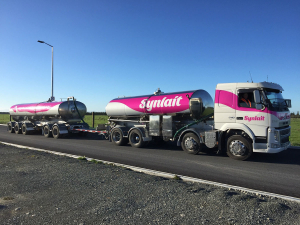
Synlait has swung to second-half profit as operations stabilise, but the dairy processor still posted a $75.4m annual loss.

LIC shareholders have elected a new North Island representative to the co-operative's Board, along with five representatives to its Shareholder Reference Group (SRG), following the company's Annual Meeting held in Invercargill.
Farmers across parts of Southland and South Otago are continuing to deal with difficult conditions after a prolonged run of wet weather, with pressure building around feed supply, stock management, pasture damage, farm infrastructure and everyday workloads.
Federated Farmers says it welcomes Labour's commitment to reviewing the Sharemilking Agreements Act, calling on other major parties to do the same.
For Canterbury dairy farmers Sian Meijer and Rick Wobben, wearable technology has become one of their most valuable on-farm tools - helping manage 1850 cows across an expansive, high-performing dairy operation while improving efficiency, mating outcomes and day-to-day decision making.
Fonterra has unveiled its annual results for the 2026 financial year, posting $27 billion in revenue and close to $20 billion returned to New Zealand farmer owners and unit holders.