$1b windfall for shareholders
Fonterra's plan to return $1 billion to shareholders in three years through the divestments of overseas milk pools is the right move, according to Waikato farmer Andrew McGiven.
 increase font size
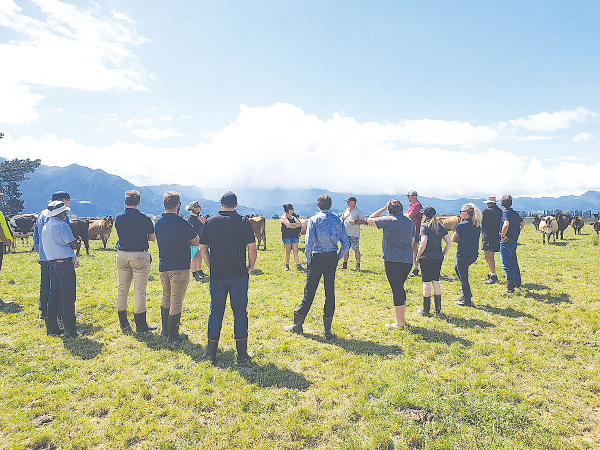 Andrew and Jenny McGiven hosted a discussion group on their farm last month to look at the positive impact of Biozest pasture spray on milk production.
Waikato farmer Andrew McGiven believes products like the pasture spray Biozest can help farmers reduce ruminate emissions.
McGiven says such products can help farmers claim carbon credits and defuse the furore around charging farmers for emissions.
He made the comments after a discussion group met on his farm last month to see the results on his farm.
Andrew and Jenny McGiven milk 500 cows on 182 hectares near Te Aroha.
"I have begun using Biozest this season, and my contract milker and I have been impressed with how our pasture base has thickened, and the plants retained palatability for longer during seed head emergence," he told Dairy News.
He pointed out that scientific papers have been published and peer reviewed showing that it can reduce methane and nitrate excretion significantly and make a more efficient milk and meat producing animal.
"We have seen a 3% increase in MS production this season compared to last year which was a record for us.
"I would like to see this research officially recognised, because if we can reduce ruminate nitrate and methane emissions with this product by up to 40-50% as claimed, then this would be a huge step towards defusing the whole He Waka Noa problem and should enable farmers to claim credits."
DairyNZ is consulting farmers on whether they should be part of the Government's Emissions Trading Scheme or a separate levy-paying scheme.
McGiven says he hasn't been to any DairyNZ consultation.
"I almost feel like it's a fait accompli that it will be a levy paying system because the ETS is worse and doesn't recognise the difference between the GHGs.
"That's why I'm keen to see technology like Biozest to be better recognised for improved pasture production, carbon sequestration, and reduced nitrate and by extension methane outputs."
Meanwhile speaking at the discussion group on McGiven's farm, Biozest inventor Nathan Balasingham pointed out that when livestock graze Biozest-treated pasture, more pasture is converted to milk and meat, therefore less is wasted as urea and methane.
"Biozest treated pasture must double its photosynthesis and in the process absorb twice as much atmospheric carbon compared to untreated pasture. This means Biozest treated pasture could sequester more carbon than an equivalent area of forestry.
"When we examined how productivity could be doubled, we pushed aside blades of grass and other pasture species, and discovered significant areas of bare earth between the crowns of pasture species."
He says Biozest-treated pasture produces more tillers to cover this bare land. This increase in pasture cover results in more efficient utilisation of water, land and fertilisers.
Balasingham says the benefit is more profit and less leaching of nitrate and other nutrients.
"Unlike nitrogen, Biozest treatment enables clover to flourish.
"Unlike gibberellic acid, you don't see rampant growth but the Biozest-treated pasture becomes denser and the improvements are sustainable."
Inefficient Ruminants
Nathan Balasingham says the Kiwi farming system is very efficient, but ruminants are woefully inefficient - only converting 25% of pasture protein to milk or meat 75% is wasted as urea nitrate and methane.
In the rumen pasture protein is rapidly broken down to amino acids then further to ammonia in the rumen.
Bacteria can only use ammonia to make protein.
He says bacteria can't use up the ammonia as fast as it is being produced, so most of it is wasted as urea.
Ammonia production process also produces the byproducts, carbon and hydrogen that are converted to methane and wasted.
"When cows graze Biozest-treated pasture the higher content of phenylpropanoids attaches to more proteins and protects it from digestion in the rumen.
"The protected protein ends up in the intestine (the true gut) where it is more efficiently digeted to amino acids and converted to milk and meat protein.
"Less protein is broken down into ammonia therefore less building blocks for methane are generated - so less urea is excreted, and less methane is emitted."
Fonterra's plan to return $1 billion to shareholders in three years through the divestments of overseas milk pools is the right move, according to Waikato farmer Andrew McGiven.
Fonterra's plan to return $1 billion to shareholders in three years through the divestments of overseas milk pools is the right move, according to Waikato farmer Andrew McGiven.
Dairy farmers are getting positive reviews from regional councils when it comes to managing effluent on farms.
King Country farmer Jacqui Hahn is Waikato Federated Farmers first woman president.
Two months ago, Andrew McGiven was planning a formal annual meeting and 75th anniversary dinner for Waikato Federated Farmers.



Now in its fourth year, the 2026 Fencing Industry Awards, formed part of the proceedings of the FCANZ Conference, held in Nelson during August.
DairyNZ deputy chair Cameron Henderson has been re-appointed unopposed for another term.
OPINION: The stats speak for themselves.
Farms across the upper North Island are trialling different pasture mixes as part of a research programme that aims to build greater resilience into farming systems.
Election years are always a concerning time for farmers, according to DairyNZ chair Tracy Brown.
The Ballance Farm Environment Awards are coming to the West Coast of the South Island.