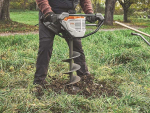
Stihl Launches BT140, Its First Battery-Powered Auger
With battery tools becoming more widespread and more importantly, productive and reliable, it was only time before we saw augers or post-hole borers.
 increase font size

EVERY SINGLE day more than six people in New Zealand, on average, injure themselves with a chainsaw – a scary statistic which is on the rise and has prompted STIHL to power up its Chainsaw Safety Awareness Week campaign.
Current ACC statistics show that New Zealanders are experiencing 185 chainsaw accidents a month, equating to nearly 50 incidents every week; and since the 2011 reporting period to the latest in 2013, there has been an increase of nearly 350 chainsaw accidents.
To help raise awareness about the importance of chainsaw safety and help lower chainsaw injuries in New Zealand, from 28 April – 4 May, STIHL is promoting Chainsaw Safety Awareness Week across the country.
An additional initiative this year will see STIHL Dealers host groups of women from the Dairy Women's Network for Chainsaw Training Sessions in five locations nationwide.
CEO of the Dairy Women's Network, Zelda de Villiers, says, "It's fantastic that STIHL is committed to raising awareness about such an important issue affecting both men and women, in such a practical and engaging way.
"Chainsaw safety is hugely relevant to dairy women throughout New Zealand as chainsaws are used daily on farms and chainsaw accidents not uncommon. By attending a training session, women will be able to step in and gain safety tips first-hand to make sure that chainsaws are used safely at home and on the farm," de Villiers says.
The Dairy Women's Network Chainsaw Training Sessions will be run by professional educators qualified to train chainsaw users, based on a pre-approved programme and will teach women how to operate a chainsaw safely, plus they'll take home some tips and tricks they can share with others.
ACC's statistics show that individual claims for chainsaw injuries have increased year on year from 2011 to 2013, but that the total spent on chainsaw claims is decreasing, meaning there are fewer serious accidents taking place but that chainsaw accidents in general are happening more frequently.
Richard Stringfellow, programme area leader for forest operations at Waiariki Institute of Technology says, "ACC's results show that it's the simple measures that people are choosing to ignore, such as a lack of personal protective equipment, poor chainsaw maintenance and misuse of the chainsaw itself.
"A quick refresher on chainsaw safety and maintenance would be incredibly beneficial for any user," says Stringfellow.
STIHL training co-ordinator, Wayne Jones says, "Chainsaws can be very dangerous, especially when users are not educated on the safe ways to operate them. Chainsaw Safety Awareness is an important message for us and our Dealers to get out to chainsaw users right across the country."
With battery tools becoming more widespread and more importantly, productive and reliable, it was only time before we saw augers or post-hole borers.

Most rural properties wouldn’t be without a chainsaw, so it’s fitting to celebrate the centenary of Andreas Stihl inventing the first portable chainsaw in a Stuttgart workshop in 1926.
STIHL outdoor products, especially petrol chainsaws and brush-cutters, have always been firm favourites with farmers and rural dwellers.
New Zealand’s special agricultural trade envoy Hamish Marr believes the outlook for the dairy sector remains strong.
A series of free workshops on animal health are being organised next month.



Waikato milk processor Tatua has again declared a record milk payout to farmer shareholders, leaving other processors in the dust.

A Labour-led Government won’t be bringing back the controversial freshwater rules of 2020.
National’s much-touted free trade deal with India featured in the Rural Issues Debate at Mystery Creek, Hamilton on Wednesday night.
New Zealand's 2026-27 freshwater fishing season has opened, with anglers encouraged to head to rivers and lakes over the coming days as conditions look favourable across much of the country.
Central Otago District Council (CODC) has voted against a plan to spread treated sewage sludge from Cromwell and Alexandra on farmland near Lauder, a decision Federated Farmers says reflects strong opposition from rural residents.
Pāmu has released its FY26 Integrated Annual Report, reporting a Net Operating Profit of $113 million, more than double the $49 million recorded in FY25.