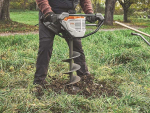
Stihl Launches BT140, Its First Battery-Powered Auger
With battery tools becoming more widespread and more importantly, productive and reliable, it was only time before we saw augers or post-hole borers.
 increase font size
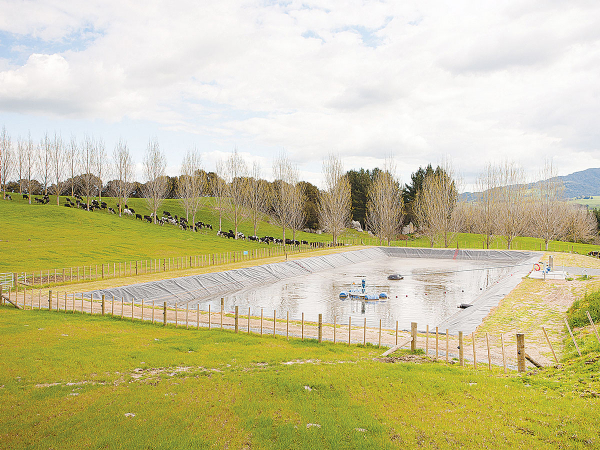 A crust-free effluent pond allows hasslefree irrigation of nutrients to paddocks.
Otorohanga farmer Grant Mitchell milks 176 cows once-aday throughout the year, so good grass growth is crucial.
To keep the grass growing, Mitchell has been tapping into “free fertiliser” from his effluent pond for the past 10 years.
Effluent is sprayed onto 7ha of the farm at a time and within a week the cows can graze that area.
To make sure that the effluent is easily irrigated, Mitchell says he has been using the Impact effluent treatment from Bioworks, pouring five litres of the product into the pond every month.
Mitchell built the 1200 cubic metre effluent pond in 2009. The pond became anaerobic not long after he started using it and a thick crust formed on top.
“There was even grass growing on top of the crusted pond,” he told Dairy News.
Irrigating the crusty effluent wasn’t easy, he says. Cows were also delaying their moving to grazing paddocks sprayed with the crusting effluent. The odour from the pond was also becoming an issue.
“You couldn’t put cows onto an irrigated paddock until about three weeks after the cannon had been in the paddock,” he says.
Mitchell started looking for solutions, settling on Impact because it is formulated to speed up the pond’s natural oxidation process.
“The crust went away leaving just green water in the pond. We put them in paddocks now and the cows are there next week munching away.
“There’s no need for a stirrer now, there’s no crust and Impact does its own job. We are getting green, mixed effluent going on the grass and it’s all rich fertiliser.”
Mitchell says the bad smell has gone away.
“When I look at the pond now, it’s just full of green water. I can see bubbles coming up and I know the bacteria are doing their stuff under water.”
Making An Impact
Results of treatment:
With battery tools becoming more widespread and more importantly, productive and reliable, it was only time before we saw augers or post-hole borers.
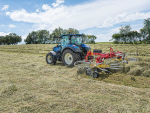
Austrian manufacturer Pottinger has released details of a new compact, linkage-mounted compact twin rotor rake, without a chassis, that is said to deliver impressive manoeuvrability.
The new Lemken Saphir XMR mechanical seed drill has been introduced as the successor to the proven Saphir 10m, with the manufacturer claiming new standards for precision, ease of use and area coverage.
Krone's XDisc 710 direct-cut header can now be used by John Deere and New Holland forage harvesters, as well as the Krone Big X it was originally designed for.
Fifty Eight years ago, on the 16th of August 1968, August Claas, the founder of the harvesting company and father of Helmut Claas, personally presented a Claas Senator combine harvester to Scottish farmer John Steven.


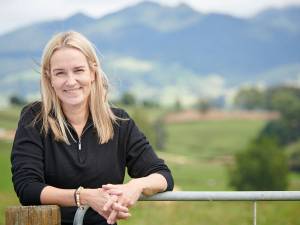
Minister of Conservation Hon Tama Potaka has appointed Susan O'Regan as Chair of the Queen Elizabeth II National Trust (QEII) for a three-year term.
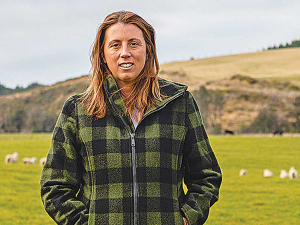
Red meat farmers are welcoming Labour’s plan to review the Emissions Trading Scheme and not to campaign on pricing agricultural emissions.
Where any worker in the kiwifruit industry is mistreated, we expect the authorities to take action.
Mid Canterbury Federated Farmers arable chair, Bevan Lill, said Beef + Lamb NZ data indicated that for the last six years, the average arable return on investment was about 0.8% while inflation ran about 4% - so the average arable farm was going backwards at about 3% a year.
Seed and grain companies share the concerns of arable farmers about the viability of their sector, says Seed and Grain New Zealand chief executive Dr Sarah Clark.
The New Zealand Institute of Forestry (NZIF) says unnecessary changes to New Zealand’s Emissions Trading Scheme (NZ ETS) will seriously erode investor confidence and result in significant reductions in forest planting rates.