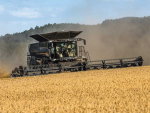
Fendt Ideal 2027: New Separation Area & Spreader Kit
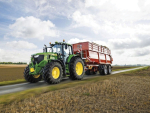
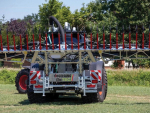
Updates to the latest models of AGCO Group’s Fendt Ideal headers for 2027 sees a greater separation area and a new straw and chaff spreader kit.
 increase font size
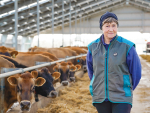
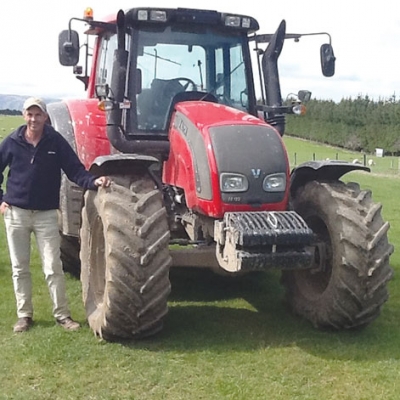 John Smith says the tractors are good value for money.
A Southland farmer’s liking for Valtra tractors coincided with his beginnings in dairy support, reports supplier Agco.
John Smith, of Wendonside, loves working with animals and is at heart a stockman. His main source of income is dairy support, and he farms Romney cross Texel sheep.
Smith says his interest in machinery is based solely on how it helps him care for his stock, and the Valtra’s – he now owns six – have served that purpose.
“I bought the first Valtra six years ago, when we first started getting into dairy support. It was good value for money, reliable and easy to drive. I’ve found that anyone can jump in and operate one without drama.”
He has since bought a new one every year.
Though the farm has three permanent workers, it is a family operation: Smith’s wife Diane runs the farm office, their three sons do most of the baling in the summer holidays and their two daughters help on the farm.
Smith started out with 400ha in the late 1970s and now farms 1220ha. Sheep alone weren’t profitable enough, so he moved into dairy support. With the dairy grazing came the need for baleage and more copping, requiring more machinery.
They now winter 6600 cows and 570 yearlings, and run 4500 sheep. They require 340ha of kale, 120ha of swedes and 100ha of barley for whole-crop. Whole-crop and grass baleage adds up to 9000 bales a year, keeping the tractors busy.
Smith’s tractors are Valtra N Series. These have a long wheelbase, good for loader work, and they are stable and versatile, Agco says.
“We chose mid-size tractors. That way we can have more of them and more flexibility, especially in November when we’re putting in crop and making baleage. We can also use smaller gear. And these tractors have better re-sale value than bigger ones.”
Smith’s policy is to sell a tractor after five or six years when it has done 5000 hours.
Valtra tractors are custom built to fit the needs of the buyer, but Smith tends to stick to basic models. “The last two have had more electronics but the previous ones were more basic.”
The oldest is an N111e (126hp). It usually tows the 3.5m discs and harrows.
Then there are three N101s (114hp). They have loaders and move a lot of baleage and do the feeding out in winter. They also pull a 12 tonne roller, 24m sprayer and, during the baling season, one takes the mower and another takes the rake.
The newest two are an N122 and an N123 (135hp). They work a six-furrow plough and a combi baler. These two have cab suspension, “a big improvement that takes the jarring out and you don’t get thrown around as much. Any new tractor we get will now have that and loader suspension.”
Valtra has a range of transmissions. The N123 is a Hi Tech 5, with 20 forward and 20 reverse gears. They are in four ranges with five steps. The driver can manually move through the gears with the push of a switch, or can set it to automatic.
Smith bought his Valtras from JJ Ltd in Gore and he says they are one of the reasons he has stuck with Valtra.
JJs does the major 1000 hour services, Smith gets on with farming.
Tel. 027 270 8027
Updates to the latest models of AGCO Group’s Fendt Ideal headers for 2027 sees a greater separation area and a new straw and chaff spreader kit.

Case IH has unveiled its redesigned next generation Puma Series tractors, said to offer improvements in connectivity, operator comfort, fuel efficiency and drivability.
AGCO’s Valtra brand has announced a production milestone at its Suolahti, Finland, factory with the completion of the 1000th AGCO continuously variable transmission (CVT).
Long-term exhibitor at Fieldays, AGCO and its Massey Ferguson brand, have several new products on display.
Given that current diesel pricing is a bit like a ride on a fairground roller coaster, it should be no surprise to hear that manufacturers are looking for alternatives.


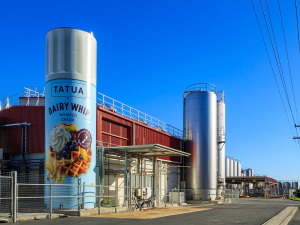
Waikato milk processor Tatua has again declared a record milk payout to farmer shareholders, leaving other processors in the dust.

A Labour-led Government won’t be bringing back the controversial freshwater rules of 2020.
National’s much-touted free trade deal with India featured in the Rural Issues Debate at Mystery Creek, Hamilton on Wednesday night.
New Zealand's 2026-27 freshwater fishing season has opened, with anglers encouraged to head to rivers and lakes over the coming days as conditions look favourable across much of the country.
Central Otago District Council (CODC) has voted against a plan to spread treated sewage sludge from Cromwell and Alexandra on farmland near Lauder, a decision Federated Farmers says reflects strong opposition from rural residents.
Pāmu has released its FY26 Integrated Annual Report, reporting a Net Operating Profit of $113 million, more than double the $49 million recorded in FY25.