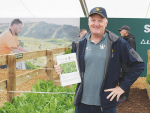
New pasture guide launched to support farmers in a changing climate
A new publication has been launched that offers a comprehensive and up-to-date resource on commercially available grazing pasture species in New Zealand.
 increase font size
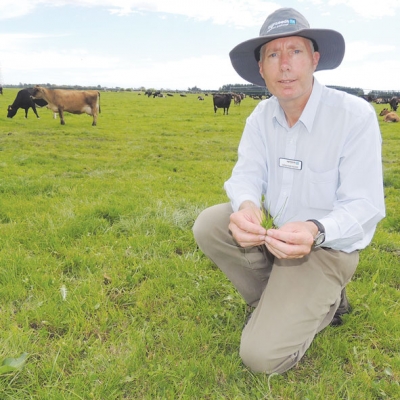 Graham Kerr, Agriseeds
Pick your paddock well and renewing pasture will pay handsomely. Get it wrong and you spend a lot of money for no gain.
That was the headline message Agriseeds’ Graham Kerr and colleague Matt Smith had for the recent Lincoln University Dairy Farm focus day.
Kerr said he often finds there’s no data to support pasture renewal decisions which is probably why an Agresearch study of returns from renewals showed, on average, no gain.
“Quite a lot of paddocks are chosen because they are ugly, not because they are not productive,” he told the focus day crowd.
When pasture monitoring and/or grazing data is analysed some ugly paddocks will be found to be as productive as those that look great, and some that look good will not be producing.
For farms using pasture monitoring software “all the data is in there. You just need to press the button and analyse it,” he stressed.
Having picked the right paddocks to renew from data, rather than perception, investigating why they’re performing poorly and putting any inherent problems right, such as fertility or drainage, as part of the renewal process is essential.
“It’s like a chain. The renewal process is only as strong as its weakest link. You’ve got to get all these things (see panel) right.”
Kerr says the checklist should be put on the wall and worked through systematically.
There’s still time to renew pasture this autumn and with a low payout the opportunity cost of production foregone while the paddock is out of the round is lower than in a high payout year, he points out.
There’s also at least one bank, ANZ, offering special low interest loans for pasture renewal, he adds.
During the focus day Kerr was asked if tall fescue or lucerne might have helped LUDF with its pasture quality problems during the summer heat.
While it was “a good question” he warned tall fescue must be grazed at lower covers to retain quality than ryegrass, which in practice means unless a large block of the farm is put into that pasture, it is hard to integrate it in a grazing round. “If you only sow one or two paddocks with it you tend to let the management slide.”
Fescue’s greater root mass than ryegrass could help it mop up more nitrogen which might be an environmental positive, he added, but Lincoln University’s professor Grant Edwards pointed out the problem is it only does that in warm weather. “It lacks cool season growth when uptake [of nitrogen] is very important.”
As for lucerne, Edwards said it has lasted well for three years in a diverse ryegrass pasture mix managed with 100-200kg/ha/year of nitrogen fertiliser.
Choosing the right paddock
Identify under-performing paddocks and rectify reasons for poor performance.
Soil test 6-12 months prior to reseed and address fertility issues.
Choose appropriate sowing date and renewal method; book contractors early.
Check for pests and plan controls: seed treatment, insecticides, endophytes?
Spray out prior to cultivation or direct drilling.
Prepare fine, firm, level seed-bed if cultivating.
Match cultivar and seed mix to farm system.
Check seed certificate for germination, purity and endophyte.
Control weeds in early establishment.
Light, early graze once it passes pluck test to promote tillering.
A new publication has been launched that offers a comprehensive and up-to-date resource on commercially available grazing pasture species in New Zealand.
New Zealand farmers know that pastoral fortunes can shift rapidly once summer’s extreme dryness gives way to cooler, wetter autumn conditions.
Pasture renewal is the process of replacing older, less productive pastures with a completely new pasture.
The Lincoln University Demonstration Dairy Farm (LUDF) is crediting a raft of improved management practises in achieving a big turnaround in empty rates.
The Lincoln University Dairy Farm (LUDF) is rethinking its approach to plantain, in the face of continued difficulty in realising its expected benefits.

Farms across the upper North Island are trialling different pasture mixes as part of a research programme that aims to build greater resilience into farming systems.
Election years are always a concerning time for farmers, according to DairyNZ chair Tracy Brown.
The Ballance Farm Environment Awards are coming to the West Coast of the South Island.
Most dairy regions around the country have had a pretty good season so far says Tracy Brown.
Rural leader Mark Hooper has been appointed as an independent director to the NZPork board, bringing extensive farming, governance and advocacy experience to the role.