Early Weaning Lambs: What the Massey Trials Found
Farmers with high-quality feed available in late spring could consider weaning at least a proportion of their lamb crop early to benefit both lambs and ewes.




 increase font size
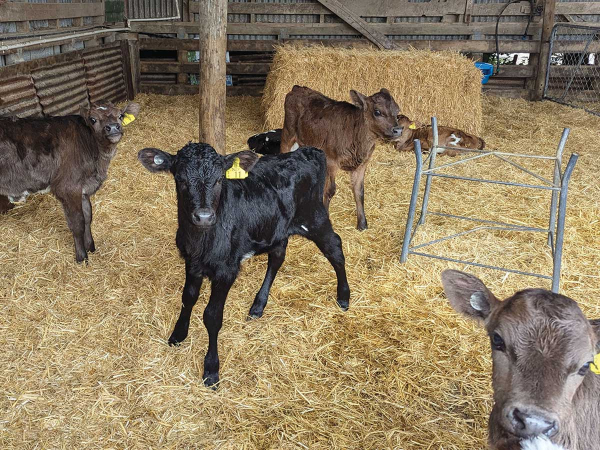 New season calves in the shed on the farm, where a range of measures has turned around the poor empty rates of recent years.
The Lincoln University Demonstration Dairy Farm (LUDF) is crediting a raft of improved management practises in achieving a big turnaround in empty rates.
The farm has typically had a notin- calf rate in recent years of 18-20%, but achieved 12% for 2022 mating, and 9% for 2023.
Antoinette Archer, the partnership and demonstration lead for the South Island Dairying Demonstration Centre (SIDDC), the partnership that runs the farm, said reproductive performance hadn’t been where it should be, for “quite some time”.
That meant a higher than ideal replacement rate coming into the herd, which impacted both financial and greenhouse gas emissions performance.
“By not having as many replacement animals coming into the herd, you can reduce your greenhouse gas footprint by rearing less animals every year. So that was a core driver.”
Much of the turnaround is due to an increased emphasis on supporting body condition though calving and into the next mating round, while a key change was putting Allflex SCR collars on all cows.
“The collars generally will give you rumination, it’ll help with heat detection, and it can also give you a bit of an illness or sickness measure as well,” said Archer.
Farm manager Peter Hancox said the collars have allowed better management and more accurate records, which brings more confidence in using tools like PG (prostaglandin) to cycle the phantom pregnancy cows.
“Five weeks after the end of week one of mating we preg-test the cows that are held in there, to make sure that they are confirmed in calf. And then we do that each week for three or four weeks, we’re picking up cows that haven’t cycled again but they’re not in calf either, so we’re able to give them a PG shot,” said Hancox.
Archer adds: “Up until now you normally leave it to do your earlies and your lates in February, whereas here you can check them earlier because you know that they’ve being inseminated, but you know that they’re not cycling from the collars.
“So you can just go in and check a portion of the herd rather than having to check every animal with it costing a lot of money.”
The farm is all AI mating, and the use of short-gestation semen has allowed them to extend mating from 10 weeks to 12 without adversely affecting the calving period.
The collars also allow the farm to monitor rumination time of cows post-calving, to decide when they are ready to rejoin the main milking herd.
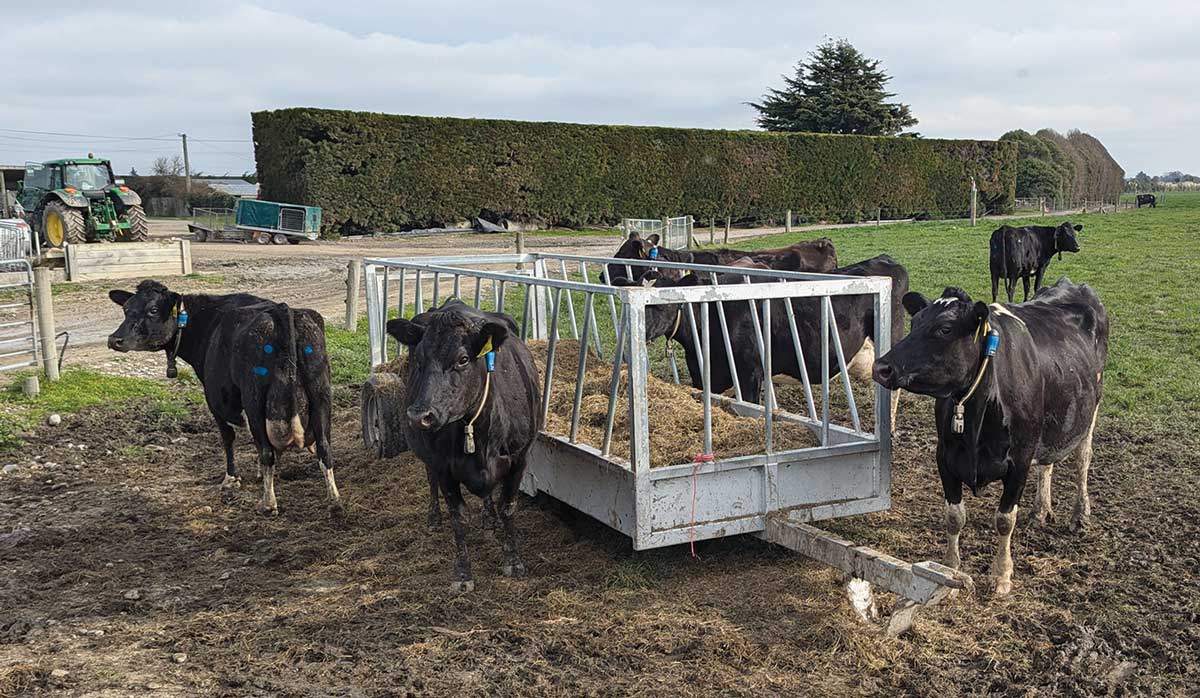 |
| Transitioning cows get a load of extra feed on the Lincoln University Dairy Farm. |
“The cows are milked just once a day post-calving for at least 10 days or when they return to 450,” said Archer.
“So some cows might be 12 or 14 days but once they recover to 450 minutes per day of rumination, we’ve deemed them to have recovered from calving so then we push them into the milking herd, which is, for us, ten in seven.”
Another factor is transition feeding. LUDF gives extra ad-lib baleage to the colostrum cows to make sure they’re eating well, for quick recovery after calving.
Archer said that body condition scores will normally drop after calving, possibly by 1 full BCS point.
“We try to limit it to 0.5 and we limited it last year to 0.2 and the year before that I think was 0.4.”
Blood testing for non-esterified fatty acids (NEFA) has confirmed the improvement.
Archer explained that high NEFA levels show that cows are mobilising body fat into their bloodstream at the expense of body condition, while good feeding keeps the NEFA levels low.
“Getting energy into them actually keeps their body condition score on.”
Meanwhile, LUDF is also looking at spring pasture levels, having previously recorded a marked drop in conception rates between weeks five and nine of mating.
Archer said that, because the farm is grass-based, with baleage as the only supplement feed used, feed levels in spring can be a bit of a challenge and the drop seemed to be linked to an energy imbalance between the herd’s needs and pasture availability. Higher applications of spring urea appear to have improved late-mating conception rates and the farm will be doing the same this season.
Farmers with high-quality feed available in late spring could consider weaning at least a proportion of their lamb crop early to benefit both lambs and ewes.
The first major update to the Dairy Cattle Code of Welfare in more than a decade has been released, marking what DairyNZ describes as an important step in ensuring animal welfare standards continue to evolve alongside scientific evidence and on-farm realities.
Bovine Viral Diarrhoea (BVD) is sometimes viewed as a dairy industry issue, but the reality is that the disease can have serious consequences for beef breeding herds as well.
Mid Canterbury Federated Farmers arable chair, Bevan Lill, said Beef + Lamb NZ data indicated that for the last six years, the average arable return on investment was about 0.8% while inflation ran about 4% - so the average arable farm was going backwards at about 3% a year.
A warning for New Zealand seed and grain companies – be prepared for an exodus of farmers from the arable sector.


Federated Farmers has welcomed new rural policies released by ACT, saying they align closely with its own election priorities.

Rural Contractors NZ says proposed changes to land transport rules for agricultural vehicles are a welcome response by the Government to out of date regulations which have seen members hit with huge fines.
Alliance is calling for final applications for its 2027 Graduate Programme, with applications closing on Sunday 25 October.
Decades piloting planes has ensured vet and farmer David Hayes is focused on safety. So, after a serious accident while welding on farm, he is sharing his experience so others can learn from it.
Canterbury milk processor, Synlait Milk has confirmed Leon Fung as its chief executive officer.
OPINION: Making it easier to collect rainwater and use it to grow crops and livestock is a no brainer.


OPINION: It seems Canterbury processor Synlait is still in the doldrums.
OPINION: Get offside with New Zealand First leader Winston Peters at your own peril.




