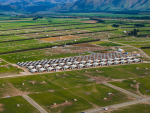
Good spring grass growth has the Lincoln University Dairy Farm (LUDF) heading for another operating profit.
Detailed figures on the farm’s performance were released for last week’s spring open day. They show the farm running 3% under budget on expenses, having been able to avoid feeding any supplements so far this season.
Ron Pellow, executive director of the South Island Dairying Development Centre, which runs the farm, says it recorded much higher growth than normally seen in August and September.
“As with others around us we’ve had a season that’s given us good growth in September-October, so we’ve been able to capitalise on that, as have others. That’s enabled us, in our situation, to come through the season feeding no supplements to date.
“A lot of people have fed less than they planned to, which is all positive. They’ve been able to utilise the pasture they’ve grown and adjust their feeding process accordingly.”
The figures also showed the costs of production running about 3% under budget.
“We have a budget of $3.85 (farm working expenses/kgMS) and on current forecasts we’re sitting on $3.72/kgMS so that’s attractive because it’s nice to be under.
“Early days of course; we are about a third of the way through the season or thereabouts, and we’ve incurred some of the big costs already, and come in under budget on some of those.
“Some of those things are gains we will take all the way through the season.”
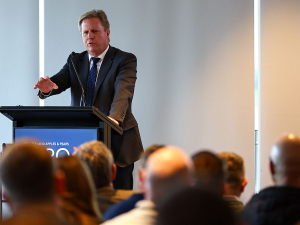
About 220 people attended the open day, one of three seasonal events held at the farm each year. (The winter event takes the form of a road trip around the wider Canterbury region.)
The event included a detailed statistical breakdown of all aspects of the farm’s performance. Pellow said that as a demonstration farm it has an obligation to show what can be done, and to provide as much detail as possible since some farmers would be more interested in some aspects of the farm’s operation than others.
The farm, which supplies Fonterra, appears on track to make a profit, given payout expectations.
“Operating profit is where we should be focussed for the vast majority of us, but that’s not an easy measure to get a good metric on. The difficulty is that it’s built up on a number of things.... So you might report your operating profit and I report mine and without knowing the assumptions that go into both of them we may not be on the same basis. But nevertheless if you want to know viability, that’s a pretty good measure of how you’re going.”
Pellow says maximising sustainable profit in essence was what most farmers are trying to do. LUDF has added some voluntary operating restraints on top of that because it is already trying to meet Ecan’s proposed 2022 environmental rules for farms in the Selwyn Waihora zone.
In its third season of working to the 2022 standards, the farm is continuing to perform well despite the weather in the past year.
“We’re achieving phenomenal performance relative to inputs,” said Pellow.