Korean marketing push for buttercup squash
New Zealand's buttercup squash was launched this week in one of the world's toughest horticulture markets, South Korea.
 increase font size
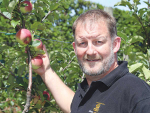
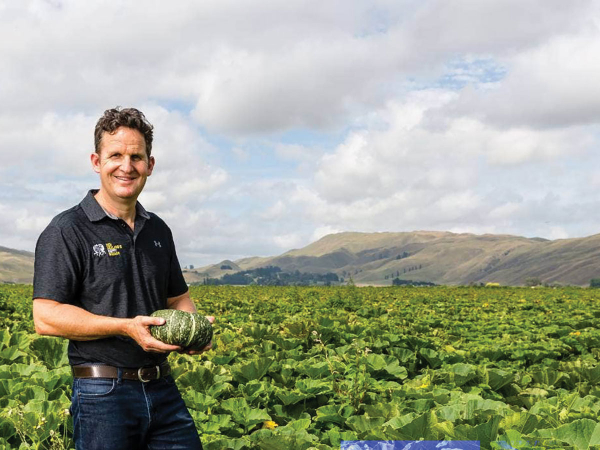 Hawke's Bay's Shane Newman is one of New Zealand's largest buttercup squash growers.
A plant 'milk' made from New Zealand-grown kabocha buttercup squash is now hitting supermarket shelves in Asia.
This comes after a partnership between a Hawke's Bay company and the Ministry for Primary Industries (MPI).
MPI contributed more than $95,000 through its Sustainable Food and Fibre Futures fund (SFF Futures) to help boost Kabocha Milk Co’s efforts to formulate, manufacture, and market a shelfstable kabocha milk recipe that would appeal to consumers in Japan, Korea, China, and beyond. It has been branded under the name ‘Kabochamilk’.
The project is a collaboration between Shane Newman – one of New Zealand’s largest buttercup squash growers from the Hawke’s Bay, and Sachie Nomura – a Japanese celebrity chef and the brains behind avocadomilk, an award-winning plant milk.
Kabochamilk is fully vegan and free from artificial flavours and colours – and “tastes outstanding”, according to Newman.
“Our Kabochamilk uses the un-exported tag-3 fruit, creating a high-value, sustainable and exportable product from produce that would otherwise go to waste,” he explains.
“It’s immensely satisfying to have hit upon a new opportunity for New Zealand’s kabocha industry.”
Newman says kabocha is a staple and regular healthy part of the Japanese and East Asian diet.
“There are no other comparable kabocha milks in any of those markets, and it became a really exciting opportunity to fill that gap.”
New Zealand is one of the largest exporters of kabocha to Japan and Korea. By tapping into the strong distribution and retail channels Newman and his family have established from over 40 years of fresh horticultural and export business, Kabochamilk is able to gain access to a large distribution network of around 5,000 Asian retailers, supermarkets, and convenience store chains.
“We’ve made agreements with powerhouse distributors in Japan and Korea that have access to thousands of retail stores,” Newman adds.
“Our products are already available in Tsurya and Harashin, high-end chain stores in Japan, which is a major coup.
“While all our product will go offshore, we’re using local farmers, local R&D, and local manufacturers, packaging, and domestic logistics companies – so the benefits to the New Zealand economy are considerable.”
Newman says the story of the kabocha being grown and produced in New Zealand is an important part of the branding.
“New Zealand growers already have very high credibility among consumers, so we emphasise the product’s origin story in our marketing,” he explains.
“The market feedback already has been extremely positive, from product concept, to taste, to brand.”
Newman says Kabochamilk is positioned as an everyday ‘milk alternative’ product that can be consumed at any time of day as a simple way of introducing healthy nutrients into the family diet.
MPI’s investment programmes director Steve Penno says Kabocha Milk Co is providing valuable employment opportunities in New Zealand’s food sector. “These opportunities will only continue to grow as the company expands,” he says. “This product promotes a positive story about New Zealand grown products, which is invaluable for our reputation.”
Penno adds that it’s also an innovative way to extract greater yield and value for NZ growers from surplus produce. Currently 10 to 15% of kabocha grown in New Zealand is used for stock food.
New Zealand's buttercup squash was launched this week in one of the world's toughest horticulture markets, South Korea.


High country stations, mixed sheep and beef farms, Māori-owned farms, corporates and family operations are among the nine commercial farms taking part in the Livestock Innovation Farming Transformation programme, known as LIFT.
OPINION: New health and safety guidance unveiled by the Government recently provides farmers greater certainty about what is expected of them when managing risks on farm.
The National Animal Welfare Advisory Committee (NAWAC) is seeking public feedback on proposed changes to the Code of Welfare for Rodeos.
A New Zealand initiative supporting farmers to restore the health of grazing landscapes has received international backing through the Regenerative Fund for Nature, a global collaborative fund supporting regenerative agriculture and the communities that produce natural fibres for the fashion industry.
Combine premium New Zealand products, blend in a family ritual and what do you get? A world-class functional drink.
Entries are now open across eleven regions for the 2027 New Zealand Dairy Industry Awards (NZDIA).