Editorial: Stay the Course
OPINION: The United States wine market has changed forever, and companies cannot use same old playbook, said Erin Kirschenmann at the New Zealand Wine 2026 Wine Business Forum in August.
 increase font size
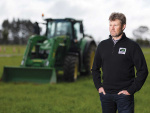
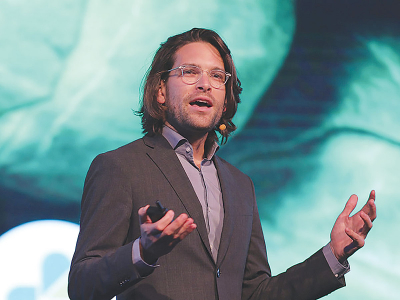 Alessandro Demaio speaking at the recent Produce Market Association A-NZ’s Hortconnections conference in Melbourne.
Globalisation is the only way to feed 9.6 billion people by 2050 with a healthy diet on a healthy planet, says a global food expert.
And there is no vegetarian wave moving across the planet, he says.
Some regions, such as Southeast Asia, need more red meat and eggs, says Australian doctor Sandro Demaio, chief executive of the global foundation EAT, in Norway.
EAT tackles human malnutrition and planetary challenges such as climate change.
Demaio spoke at the Produce Market Association A-NZ’s HortConnections conference in Melbourne, attended by Rural News. His words have implications for Australian and NZ agriculture.
Demaio says there is a discrepancy worldwide in the quality and quantity of food we can grow on a hectare of land -- partly about “climate and access to water”.
“We need to think about that. We need to be growing food where it is going to grow most efficiently.”
Demaio disputes any obsession with winding back globalisation. “In fact the only way we are going to feed 9.6 billion people is to dramatically increase trade”.
Countries must get over the idea of food sovereignty or the historic need to produce enough food for an entire country.
“Some countries will obviously be exporters, but with others we will need to strengthen multilateral relationships to ensure trust exists so that long term our global trading system will be able to feed a growing world,” Demaio said.
The biggest challenge now is not just to produce more food from present resources, but to produce more of the right food.
“It sounds simplistic, but we live on one planet, we have one global food system. Food needs to be grown where it can be grown most efficiently with the limited amount of resources we have.”
He says globally we are under-consuming fruit and vegetables, whole grains, nuts, seeds and healthy oils. But the South Asian region is under-consuming in different ways.
“We will need to increase red meat consumption by most Southeast Asians… and eggs. There is a huge investment now in scaling up egg production in Africa and the same need will emerge in the Southeast Asian region.”
The nutritional potential of eggs for the most vulnerable people worldwide needs to be realised. That includes the young, especially young women, who need animal-sourced protein in general.
A bit of meat on the side
While vegan and vegetarian numbers in Europe and North America are stable, interest is surging in ‘flexitarianism’ – a plant-based diet with some meat.
“There is no vegan wave moving across the world and everyone is going to give up meat tomorrow,” Demaio explains.
“But people are interested in the meat they are eating in a way they haven’t been previously.”
This holds a challenge to meat producers and an opportunity “because those same people are interested in paying more for quality meat”.
“How do we shift the economic incentives and levers to ensure we put more vegetables on the plate or move to farming practices that better support farmers and farming communities and give them a fair wage? Demaio asks.
“How do we take consumers with us so policymakers are able to rethink the market incentives and the fiscal policies that allow us to make that transition?”
OPINION: The United States wine market has changed forever, and companies cannot use same old playbook, said Erin Kirschenmann at the New Zealand Wine 2026 Wine Business Forum in August.
Chinese beef trade quotas and a looming suspension of Brazilian beef imports into the European Union are expected to reshape global beef trade flows over the remainder of 2026, with implications for New Zealand exporters, according to Rabobank's Q3 Global Beef Quarterly report.
China remains New Zealand’s biggest market, taking $23 billion of our exports, but it’s no longer a commodity story, says Prime Minister Christopher Luxon.
According to new research, industry leaders have ranked world-class biodiversity as the number one priority for the 16th year in a row.
OPINION: This is my last article as Chief Executive, so I thought I’d take the opportunity to talk about three recurring issues which I have seen over the years, and which are almost certain to be issues in the future.


National’s pledge to introduce 19 new national standards shows the party is serious about getting Wellington out of farming, Federated Farmers says.
The National Party’s policies to make it easier to grow fresh vegetables, secure reliable water and energy and simplify farm planning are practical changes that will give growers the confidence to invest, according to Horticulture New Zealand (HortNZ).
Fonterra Co-operative Group chief financial officer Andrew Murray has resigned to take up a role outside the dairy giant.
A major move is about to get underway to improve the quality and viability of dairy beef and cattle in NZ.
Veterinarians say changes to the code of welfare for dairy cattle provides a positive foundation for improved cattle welfare across the country.
Today, 15 October, is the International Day of Rural Women, which recognises rural women’s contribution to farming, communities and the environment.