Ospri Urges Farmers To Prepare NAIT Records Before Moving Day
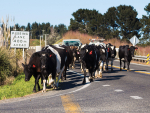
Moving Day (June 1) is just around the corner and farmers who are moving farms with the herd are being urged by Ospri to start preparations now.
 increase font size
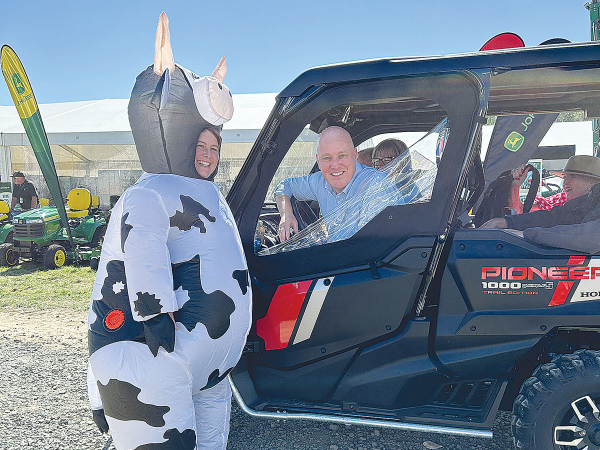 Prime Minister Christopher Luxon meeting Lucy the inflatable cow at Southern Field Days.
From November 1, 2023, Ministry for Primary Industries’ Mycoplasma bovis Eradication Programme has been contracted out to disease management agency OSPRI, as it enters a long-term surveillance phase.
The change marks the transition of the whole programme to a management agency, with the goal of eradicating M. bovis in New Zealand by 2028.
OSPRI took the opportunity to reinforce how well the programme had dealt with the issue, given that most other countries believed the task was impossible, but also reminding farmers of the need to be vigilant.
NAIT was designed to provide fast and accurate tracing of animals (deer and cattle) to support disease management in NZ, provided farmers “bought into” recording and supplying movement data in a timely manner.
Louisa Sahin, regional partner extension services for OSPRI, says the best way for farmers to help shut the gate on diseases like M.bovis is to keep accurate information about themselves, their farm and their herd via the NAIT system.
Noting that disease can spread rapidly through any locality, OSPRI highlighted the need to record and report animal movement onto or off farms within 48 hours of any such actions.
Sahin notes that she had heard reports of some stock owners being reluctant to tag animals, maybe because of losing tags accidentally. Rather, they preferred to tag animals as they left a property, likely to result in mistakes at the last minute. Helping visitors to Southern Field Days recently to have a little fun with this serious message, a roaming inflatable cow called Lucy was seen to be posing for the obligatory selfie with young and old, and even Prime Minister Christopher Luxon.
Moving Day (June 1) is just around the corner and farmers who are moving farms with the herd are being urged by Ospri to start preparations now.
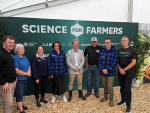
While the District Field Days brought with it a welcome dose of sunshine, it also attracted a significant cohort of sitting members from the Beehive – as one might expect in an election year.
After what has been a difficult year with redundancies and factory downsizing, John Deere is reversing course, announcing it will bring 140 employees back to its Waterloo, Iowa operations as demand increases for its 8R and 9R tractors.
Austrian manufacturer Pöttinger gave a sneak peek of a new automatic swath placement system for the Novacat V 10000 ED/RC Collector mowers at Agritechnica 2025, and recently confirmed that the upgrade will be available for the upcoming European mowing season.
Mahindra & Mahindra, the world's largest tractor producer by volume and India's leading automobile manufacturer, has announced plans to establish its largest integrated automobile and tractor manufacturing facility in Nagput, Maharashtra, marking a major expansion of its manufacturing footprint.


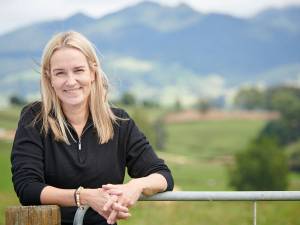
Minister of Conservation Hon Tama Potaka has appointed Susan O'Regan as Chair of the Queen Elizabeth II National Trust (QEII) for a three-year term.
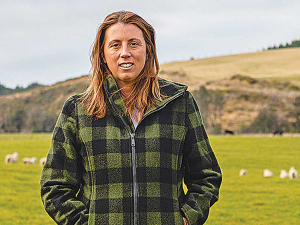
Red meat farmers are welcoming Labour’s plan to review the Emissions Trading Scheme and not to campaign on pricing agricultural emissions.
Where any worker in the kiwifruit industry is mistreated, we expect the authorities to take action.
Mid Canterbury Federated Farmers arable chair, Bevan Lill, said Beef + Lamb NZ data indicated that for the last six years, the average arable return on investment was about 0.8% while inflation ran about 4% - so the average arable farm was going backwards at about 3% a year.
Seed and grain companies share the concerns of arable farmers about the viability of their sector, says Seed and Grain New Zealand chief executive Dr Sarah Clark.
The New Zealand Institute of Forestry (NZIF) says unnecessary changes to New Zealand’s Emissions Trading Scheme (NZ ETS) will seriously erode investor confidence and result in significant reductions in forest planting rates.