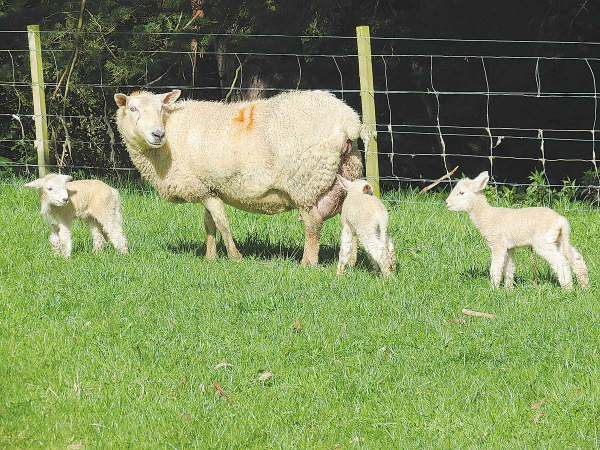
High quality feed, reduced stocking rates and shelter will all help enhance triplet lamb survival and ultimately benefit the bottom line.
While rumen size does not differ between twin and triplet-bearing ewes, if one group is to be given preferential feed, it should be ewes with triplets.
Supplementary feeding may be required where feed is short, but this should be a high energy feed such as peas, grain or sheep nuts and the ewes introduced to these feeds slowly. Average or poor-quality hay or silage are not recommended as they provide too much bulk.
Farm trials have shown that there is no advantage to feeding high-protein supplements to ewes on high quality pasture. Typically, it is energy that is the limiting factor, not protein.
pregnancy increases the risk of sleepy sickness and is likely to result in smaller, less vigorous lambs and poor mothering behaviour. Colostrum and milk intake will be reduced and lambs will be lighter at weaning.
Avoid set-stocking triplet-bearing ewes too early. This could result in available feed being consumed too early and this will impact on lactation.
If feed is limited, then consider supplementary feeding singles and giving the best pasture to the ewes with triplets.
Set-stock triplet-bearing ewes at no more than 10 ewes/ha to minimise disturbance and avoid paddocks with steep topography.
At birth, the temperature of a triplet lamb is lower than that of a twin lamb and they lose heat faster due to their smaller size. Shelter will help reduce thermal heat loss and improve survival.
In highly fecund flocks, it is estimated that 25% of lambs are at risk from pre-birth to 12 weeks of age.
Storms can heighten the risk of mismothering and exposure, and hand rearing may be an option.
Key Points
- Provide high quality feed in the lead up to lambing.
- Supplement triplet-bearing ewes with high energy feed when pasture is short.
- Avoid set stocking too early.
- Set stock at less than 10 ewes/ha.
- Provide shelter – triplet lambs are more vulnerable in cold weather.
- Feed is the most critical factor going into lambing and ideally, in the four to six weeks before lambing, triplet scanned ewes should be offered good quality pasture of at least 1,200kg DM/ha (approximately 4cm high) with an ME of at least 11MJ/kgDM.